
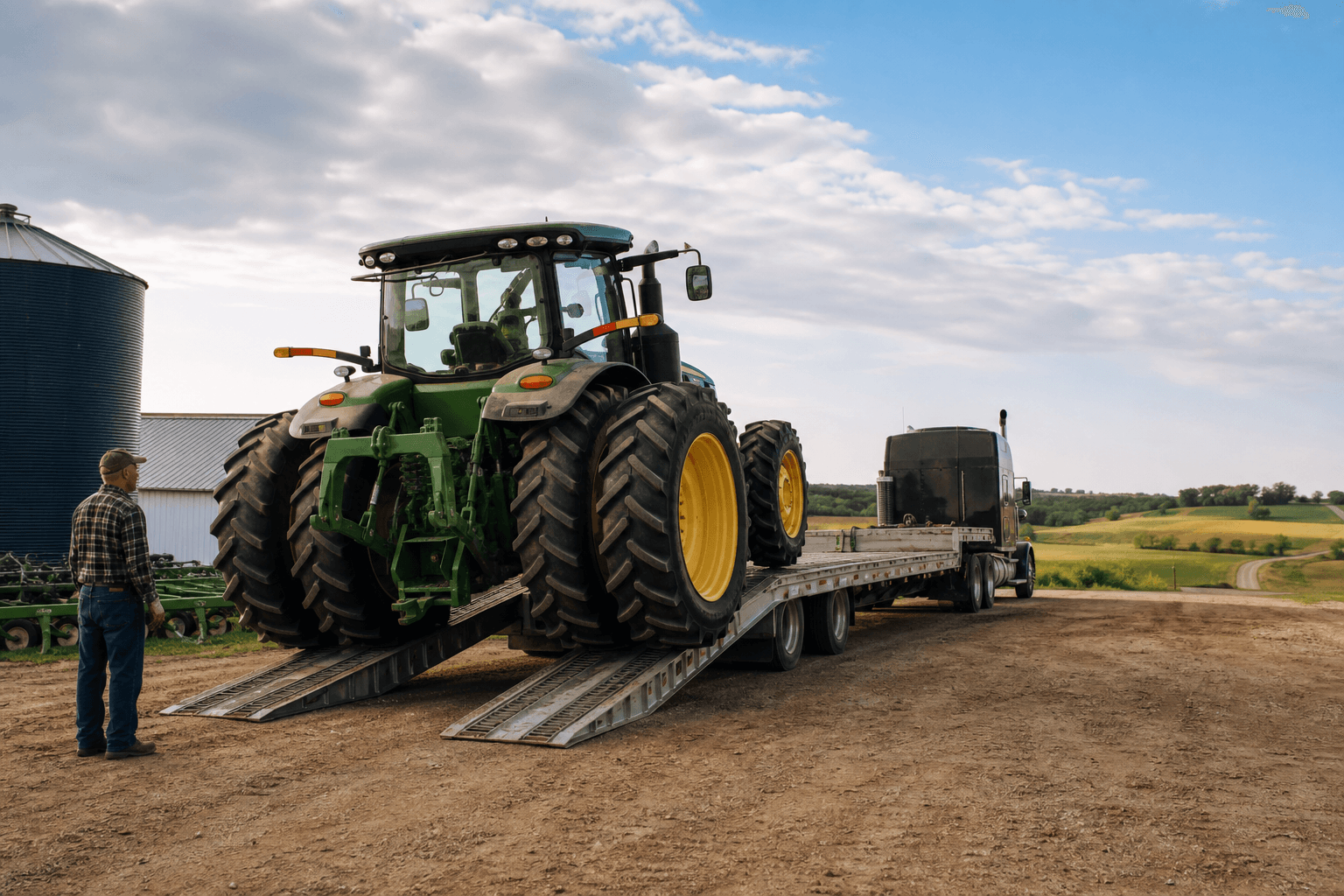
Agricultural machinery loading is not just the moment a tractor, hopper, or implement goes onto a trailer. It is a transport-planning decision that starts with accurate dimensions, operating weight, attachments, site access, route conditions, and the right vehicle.
Gathering those details before requesting a quote helps a carrier assess the move accurately and identify issues before loading day. It also helps you decide whether direct pickup, regional or long-haul flatbed transport, wide-load planning, expedited service, or temporary staging is the better fit.
What to confirm before requesting a farm equipment transport quote
A useful quote begins with a complete shipment brief. A carrier needs more than the machine’s general name because equipment in the same category can have very different weights, widths, heights, and loading requirements.
Identify the machine and its travel condition
Record the make, model, equipment type, operating weight, overall length, width, and height. Measure the machine in the configuration in which it will be transported. Note whether it is running, towable, partially dismantled, or dependent on another machine or method for loading.
List every attachment and removable component. Buckets, booms, dual wheels, headers, tanks, blades, augers, folded extensions, and other accessories can change final dimensions or weight distribution. Do not assume an attachment will be removed unless that responsibility has been agreed in advance.
Describe both ends of the move
Provide pickup and delivery addresses, preferred dates, site contacts, and access conditions. Mention narrow entrances, soft ground, field access, slopes, overhead obstructions, loading areas, turning limitations, and whether the destination can receive a large vehicle.
State whether loading and unloading equipment is available at either location. A carrier should know whether the machine can be driven onto the trailer, needs another arrangement, and who will coordinate each step.
Flying Falcon states that it transports agricultural machinery, grain and seed hoppers, crops, and other heavy or specialized cargo. Its grain and seed transport information also highlights trained crews and difficult field or off-road access when applicable. These are useful subjects to raise during a quote discussion, without assuming that every site or machine can be handled the same way.
Loading mistakes that can delay or complicate a machinery shipment

Using estimates instead of current measurements
Catalogue dimensions or an old equipment sheet may not reflect the machine’s current setup. Added implements, replacement tires, raised components, or temporary equipment can affect clearance and legal dimensions. Incorrect information can lead to a vehicle or route plan that no longer fits the actual load.
Measure length, width, height, and weight as close as practical to the shipment date. If the figures are uncertain, tell the carrier rather than presenting an estimate as confirmed.
Leaving attachments and condition details until loading day
An attachment that remains installed may change how the machine is positioned, loaded, secured, or unloaded. Fluids, loose parts, removable counterweights, and damaged or non-operational components can also affect preparation.
Ask which items should remain attached and which should be removed, and clarify who handles that work. The correct choice depends on the equipment, transport setup, dimensions, and loading conditions.
Choosing a vehicle without checking capacity and braking
A trailer must suit the machine’s weight and dimensions, but the towing vehicle and complete combination must also handle the load safely. Alberta farm-equipment safety guidance emphasizes matching the load to the towing vehicle and ensuring that it can safely brake for it. Review Alberta’s farm-equipment safety guidance and ask how those considerations apply to your shipment.
Avoid selecting a provider solely because a trailer appears available. Ask whether the proposed equipment fits the machine’s actual weight, dimensions, condition, and loading method.
Treating access as an afterthought
Even a legally sized machine can be difficult to collect or deliver if a site has soft ground, tight turns, low clearance, or no suitable loading area. Field access may require additional coordination, particularly after weather changes.
Send photographs, site notes, or a simple access sketch when the location is difficult to describe. Early disclosure gives the carrier a chance to assess the plan before the truck arrives.
Planning loading without planning unloading
Give the delivery location the same attention as the pickup location. Confirm where the machine will go after leaving the trailer, whether it can be driven away, and whether the receiving party has the people or equipment needed to unload it.
Clarify securement responsibilities, delivery communication, and what happens if the site is inaccessible on arrival. These questions reduce avoidable uncertainty.
Match the shipment conditions to the right transport questions
The service label matters less than the conditions of the move. Use these questions to focus the conversation with a carrier.
| Shipment condition | Questions to ask before booking |
|---|---|
| Local or regional repositioning | Can both sites accommodate the vehicle, and is the machine ready to move without staging? |
| Movement across Alberta, British Columbia, or Saskatchewan | Which access, timing, and route details could affect the short-haul plan? |
| Long-distance shipment | How will dimensions, securement, delivery access, and communication be coordinated? |
| Oversized or unusually heavy machinery | Which measurements and weights determine the transport category, permit review, and route planning? |
| Urgent or time-critical move | Is expedited service appropriate, and what information is needed to assess availability? |
| Machine that cannot move directly between sites | Would temporary storage, cross-docking, or a transfer between shipment legs simplify the move? |
Flying Falcon describes short-haul service in Alberta, British Columbia, and Saskatchewan, along with long-haul, LTL, hot-shot expedited, and specialized flatbed transportation. For a machine that may exceed ordinary dimensions, review its wide-load transportation considerations and ask which details must be confirmed before a quote.
Vehicle capacity, loading access, and unloading conditions
Loading should be planned around the equipment’s actual condition and the site’s physical limitations. Confirm whether the machine can be driven, rolled, or otherwise positioned for transport. If it is inoperable, damaged, or unable to climb a loading surface, state that clearly before a solution is proposed.
Ask what loading and unloading arrangements are expected at both ends. Do not assume that a carrier supplies a specific crane, ramp, forklift, winch, or trailer configuration unless it is confirmed. The relevant question is not simply whether the carrier moves farm equipment, but whether the proposed plan fits this machine and these sites.
For grain hoppers and similar agricultural equipment, terrain can be particularly important. Describe ground conditions, seasonal access, and restrictions that could affect the vehicle’s approach.
Alberta dimensions, weight, and permit checks
In Alberta, oversize and overweight loads may require permits, with permit conditions intended to support safety and protect highway infrastructure. Check Alberta’s current oversize and overweight permit information early rather than waiting until loading day.
Measure the complete loaded combination, not just the machine. Alberta safety guidance also identifies circumstances in which farm equipment exceeding specified height or width thresholds may require an over-dimensional permit on roads. Review the relevant Alberta safe-transportation guidance and ask the carrier or appropriate authority how current requirements apply.
Permit requirements can depend on the full vehicle, route, dimensions, weight, and travel conditions. This article is not a permit determination, so provide complete measurements and allow time for assessment.
When staging, storage, or cross-docking can improve the loading plan
Direct pickup is not always the simplest option. A machine may be ready before the destination can receive it, several pieces may need to be consolidated, or the shipment may need to change between local and long-distance legs.
Temporary storage or cross-docking can separate the loading event from final delivery. It may also help when equipment must be held between a farm, dealer, project site, or onward carrier. Confirm handling responsibilities, storage duration, access requirements, and inventory records first.
For shipments needing an interim location in the Edmonton area, warehouse and logistics solutions may help coordinate storage, loading, unloading, cross-docking, or distribution. The right choice depends on the machinery, timing, site constraints, and number of shipment legs.
Pre-quote checklist for agricultural machinery loading
- Machine type, make, model, and operating condition.
- Current length, width, height, and operating weight.
- All attached, removable, folded, raised, or loose components.
- Whether fluids, counterweights, tires, or accessories change the configuration.
- Pickup and delivery addresses, site contacts, and preferred dates.
- Ground conditions, field access, turns, slopes, overhead clearance, and receiving space.
- Whether the equipment can be driven or needs another loading arrangement.
- Who will load, unload, prepare, and inspect the machinery.
- Whether the move may involve oversize or overweight dimensions.
- Whether direct delivery, temporary storage, or cross-docking is preferred.
- Any urgent timing, cross-border, insurance, tracking, or communication requirements.
Attach clear photographs when they explain the machine’s configuration or site access. A concise brief gives the carrier a stronger basis for discussing vehicle suitability, route planning, loading responsibilities, and the quote.
Questions to ask the carrier before loading day
- Have you reviewed the machine’s complete dimensions and operating weight?
- What transport setup is being considered, and why does it fit this load?
- Who is responsible for loading, unloading, preparation, and securement?
- What site or access information is still needed?
- Could the dimensions or weight require an Alberta permit review?
- How should attachments, loose components, and non-operational equipment be handled?
- What updates will be provided during pickup and delivery?
- Would short-haul, long-haul, wide-load, expedited, storage, or cross-docking support best match the move?
Frequently asked questions
What information does a carrier need for an agricultural machinery transport quote?
Provide the machine type, current dimensions, operating weight, attachments, condition, pickup and delivery locations, site access, loading and unloading arrangements, preferred timing, and any storage or cross-docking needs. Photos and equipment specifications can clarify the request.
When might agricultural machinery require an oversize or overweight permit in Alberta?
A permit may be needed when the complete loaded vehicle exceeds applicable legal dimensions or weight limits. Certain height and width conditions can also trigger over-dimensional requirements. Confirm current requirements for the machine, vehicle, and route with the carrier and Alberta authorities.
Can agricultural machinery be stored or cross-docked before final delivery?
It may be possible when the shipment needs to pause, consolidate, or transfer between transport legs. Ask about space, handling, access, timing, and responsibility for inspecting the machinery before selecting this option.
Should attachments be removed before farm equipment is loaded?
Not always. Removing an attachment may reduce dimensions but can create separate handling and storage requirements. Ask the carrier to assess the travel configuration and confirm who will remove, protect, transport, and reinstall components.
Make the loading plan part of the transport plan
Treat agricultural machinery loading as one part of the complete shipment. Confirm real dimensions and weight, disclose attachments and condition, describe both sites honestly, and ask how vehicle capacity, route requirements, permits, securement, and unloading will be addressed.
Then choose the structure that fits the move. Direct flatbed transport may suit a straightforward load, while short-haul repositioning, long-haul transport, wide-load planning, expedited service, storage, or cross-docking may be more appropriate when access, timing, or dimensions create constraints.
For agricultural machinery transport, flatbed freight, specialized hauling, and related logistics planning across Canada and the United States, contact Flying Falcon Logistics Ltd with the completed pre-quote details so the shipment can be assessed before loading day.


