
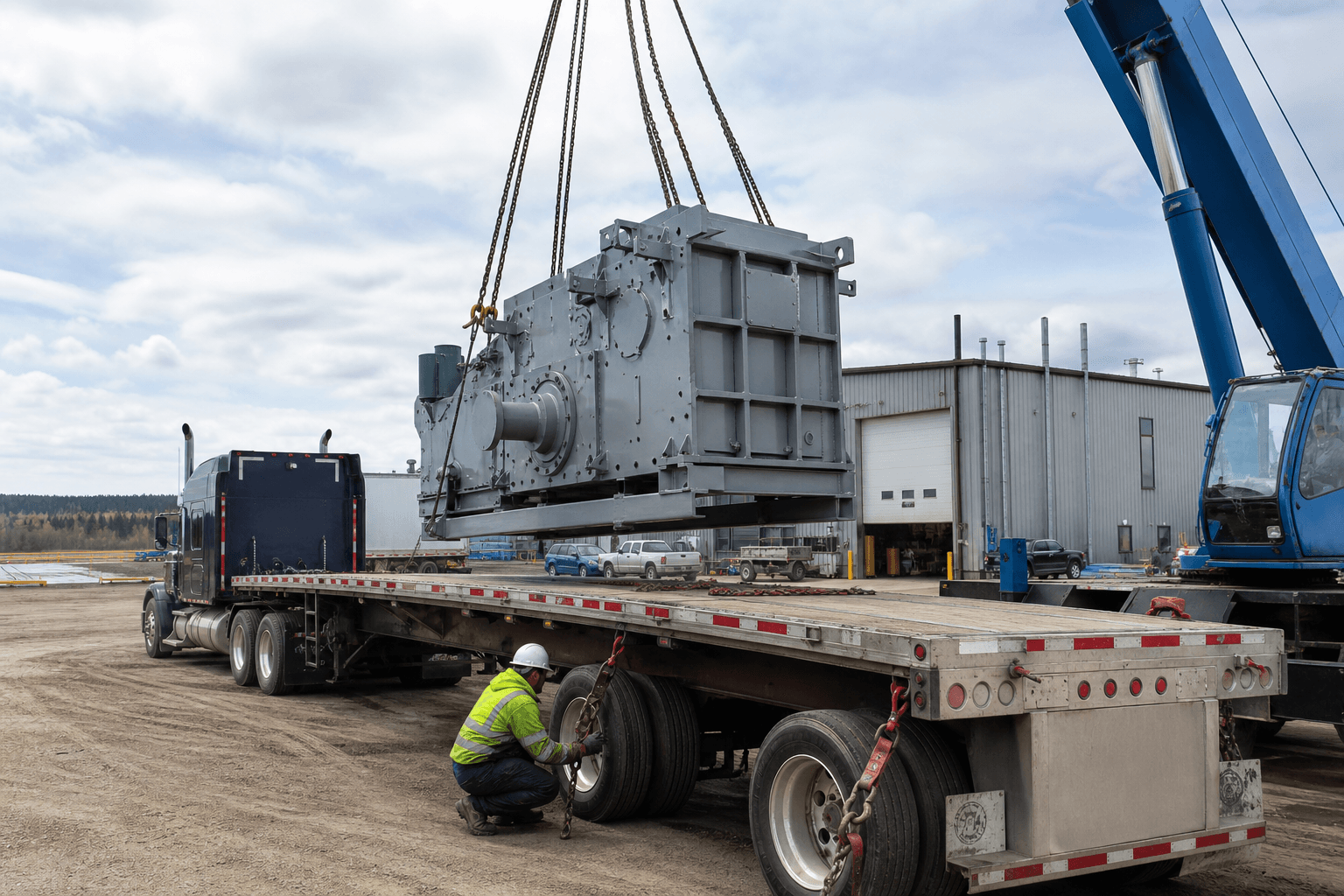
Flatbed trucking load securement should be planned before freight reaches the loading dock. The correct approach depends on the cargo's weight, dimensions, shape, center of gravity, loading points, trailer, weather exposure, and route. A tie-down method that suits packaged steel may not suit a wheeled machine, container, or irregular industrial component.
For shippers, the key decision is not simply which straps or chains to use. It is whether the carrier has enough accurate information to plan the equipment, blocking, bracing, tie-downs, edge protection, permits, and route coordination the move may require. Alberta requires commercial vehicles over 4,500 kg licensed mass to secure cargo according to National Safety Code Standard 10, while requirements for cross-border and interprovincial movements must be considered for the actual route. Alberta's vehicle standards and Transport Canada's commercial vehicle safety information are useful starting points for confirming the applicable framework.
What determines the right flatbed securement plan?
There is no universal load securement method for flatbed freight. The plan must control movement in the directions relevant to the cargo and journey while keeping the load distributed appropriately on the trailer. The Alberta commercial-carrier education materials address cargo-securement obligations, equipment, tie-downs, and cargo carried on trucks and trailers. Alberta's cargo-securement module can help carriers and shippers understand why the details of each load matter.
- Cargo characteristics: Weight, length, width, height, shape, surface, fragility, and whether the item can roll, slide, tip, shift, or deform all affect planning.
- Center of gravity: A tall, uneven, or machinery-based load may need more careful placement and stabilization than a low, evenly distributed product.
- Attachment points: The carrier needs to know where approved tie-down points exist and whether the cargo has exposed edges, delicate components, or surfaces that need protection.
- Loading method: Crane loading, forklift loading, drive-on loading, ramps, and dock transfers create different handling and positioning questions.
- Trailer and route: Deck configuration, available securement equipment, road conditions, weather, distance, border crossings, and jurisdiction can all influence the plan.
These details should be resolved before dispatch, not improvised after the truck arrives. If the cargo changes in weight, dimensions, packaging, or loading method, the securement discussion should be revisited.
Shipper responsibilities versus carrier checks

Securement is a shared planning exercise, even though the shipper and carrier contribute different information and checks. The shipper is usually best placed to provide accurate cargo data and explain how the freight can be safely lifted, supported, and accessed. The carrier and driver can then assess the proposed movement against the available equipment, route, and applicable requirements.
| Shipper should provide | Carrier should confirm before departure |
|---|---|
| Exact dimensions, weight, quantity, and cargo description | Trailer suitability, load placement, weight distribution, and available securement equipment |
| Center-of-gravity information and approved loading or tie-down points | Whether the proposed securement approach is suitable for the cargo and route |
| Loading, unloading, lifting, blocking, and bracing requirements | Whether additional equipment, protection, permits, route coordination, or handling support is needed |
| Packaging limitations, exposed edges, fragile components, and tarping needs | Final inspection of the load, securement, clearance, documents, and visible signs of movement or instability |
This division is not a substitute for checking the rules that apply to a specific operation. Alberta's carrier education materials explain that cargo securement is part of broader commercial vehicle safety compliance, so a shipper should not assume that providing a weight is enough to transfer every planning decision to the driver.
Securement questions by freight type
Freight type is a useful starting point for identifying questions, but it does not determine a complete securement method by itself. The cargo's actual condition, dimensions, weight, and loading points still need to be assessed.
| Freight type | Questions to resolve before loading |
|---|---|
| Heavy machinery | Where is the center of gravity? Can wheels, tracks, booms, buckets, or attachments move? Are there manufacturer-approved tie-down points? Does the machine need blocking, lowered components, or additional protection? |
| Steel products | Are pipes, beams, plate, or coils likely to roll, slide, or shift? What supports prevent movement? Do sharp edges require edge protection? Will the shape create concentrated weight or unusual height? |
| Containers | What are the container's verified gross weight and dimensions? How will it be placed and restrained on the selected trailer? Are lifting, transfer, or cross-docking arrangements part of the move? |
| Agricultural equipment | Can wheels, folding sections, implements, or raised components move during transit? Does the equipment need to be folded, locked, drained, or protected before loading? Is its width within ordinary transport limits? |
| Irregular freight | Which surfaces can take pressure? Are there protrusions, fragile parts, uneven bases, or unusual clearance concerns? Would a site inspection, custom blocking, tarping, or route review be appropriate? |
Flying Falcon's verified service information identifies heavy equipment, wide-load freight, containers, steel products, and agricultural goods among the types of freight it handles. That kind of freight-specific conversation is important because a carrier should understand the item itself, not only its total weight.
Pre-shipment flatbed load securement checklist
Use the following checklist when preparing a quote request or coordinating a confirmed shipment. It is a planning aid, not a replacement for the carrier's inspection or the requirements governing the route.
- Describe the cargo: Identify the item, quantity, packaging, condition, and any detachable, movable, or fragile components.
- Record measurements: Provide the loaded length, width, height, and weight. Include dimensions after folding, packing, crating, or adding attachments.
- Explain weight distribution: Identify the center of gravity, concentrated weight, axle-related concerns, and any restrictions on where the cargo can be supported.
- Identify loading points: State whether the cargo has rated or manufacturer-approved tie-down points and whether those points can be reached after placement.
- Plan loading and unloading: Confirm the crane, forklift, ramp, dock, lifting, blocking, and bracing arrangements at both ends.
- Discuss protection: Flag sharp edges, painted surfaces, sensitive components, weather exposure, tarping requirements, and any areas that must not be contacted.
- Confirm route factors: Share origin, destination, border details, timing, road restrictions known to the shipper, and whether the load may exceed ordinary dimensions or weight limits.
- Review documents: Confirm the commercial paperwork, shipment instructions, permits or approvals where applicable, and any cargo-specific handling information.
- Inspect before departure: The final check should verify the load's position, distribution, securement, clearance, protection, and visible condition before the truck leaves.
When securement becomes wide-load or heavy-haul planning
Ordinary cargo securement is only one part of a move when freight exceeds legal dimensions or involves exceptional weight. Flying Falcon's wide-load information notes that over-width loads can require special permits and that escorts or pilot cars may be required in some circumstances. The exact requirements depend on the jurisdictions, route, dimensions, weight, and other conditions, so they should be confirmed rather than assumed.
Start this discussion as soon as the cargo's preliminary dimensions and weight are known. The carrier may need time to review the route, identify clearance or restriction concerns, determine whether specialized equipment is appropriate, and coordinate permits or escorts where applicable. Do not wait until loading day to disclose that an attachment makes the shipment wider or taller than the main piece of equipment.
Why route and jurisdiction change the requirements
A shipment staying within Alberta, moving between provinces, and crossing from Canada into the United States may face different regulatory and operational questions. Transport Canada explains that cargo-securement rules apply to carriers operating across provincial or territorial boundaries or across an international border, while provincial legislation governs applicable intraprovincial operations. Alberta's commercial-carrier education materials provide additional context for operations governed by Alberta requirements.
For a cross-border move, confirm the full route and border crossing early. Securement is only one planning item. The carrier and shipper may also need to coordinate shipment descriptions, commercial documents, dimensions, timing, and any permit or inspection considerations that affect the movement. A route that works for a standard flatbed may not work for the same freight when the load is wider, taller, heavier, or handled differently.
How to evaluate a carrier before booking
Choose a carrier based on the fit between its equipment, experience, communication, and your freight's actual requirements. Look for clear answers to these questions:
- Has the carrier handled this type of freight, including its unusual dimensions, shape, or loading method?
- Can it explain how the securement discussion will happen before pickup?
- Does it have a clear process for wide-load, heavy-haul, interprovincial, or cross-border coordination?
- Can it manage intermediate handling if the shipment requires storage, staging, or transfer?
- Will the quote identify assumptions about dimensions, weight, loading, timing, permits, and access?
A carrier's flatbed transportation services should include the equipment and experienced drivers needed to secure freight safely for the full journey. Flying Falcon Logistics is an asset-based Canadian flatbed and specialized freight carrier based in the Edmonton and Nisku area, with stated service across Canada and the United States and capability for heavy and wide-load transportation. Those facts can make it a relevant option to discuss, but the shipment still needs to be assessed individually.
What to include in a freight quote request
A useful quote request gives the carrier enough information to judge securement, equipment, routing, and handling requirements. Include:
- Pickup and delivery addresses, including site access restrictions
- Cargo description, quantity, packaging, and condition
- Exact length, width, height, and weight for each piece
- Center of gravity, tie-down points, attachments, and movable components
- Loading and unloading equipment available at each location
- Required pickup and delivery dates, time windows, and urgency
- Whether the shipment is staying in Alberta, moving interprovincially, or crossing the Canada to United States border
- Whether storage, staging, LTL consolidation, cross-docking, permits, or escorts may be needed
Photos, drawings, manufacturer instructions, or a packing list can also clarify the load when dimensions alone do not show its shape or handling risks. If any information is estimated, label it as an estimate and provide the confirmed figures before loading.
When warehousing or cross-docking affects the plan
Intermediate handling can change the securement conversation. If freight is unloaded, stored, consolidated, or transferred between LTL and full-truckload movements, the original arrangement may not remain intact. The shipper should tell the carrier whether the cargo will be staged, repacked, accessed, or loaded onto a different trailer.
Flying Falcon states that its Edmonton-area warehousing and logistics services include storage, loading, unloading, distribution, and cross-docking. For a shipment using those services, confirm who will handle each transfer, whether blocking or packaging will be changed, and when the final flatbed securement inspection will occur.
Frequently asked questions
Does every flatbed shipment require special cargo-securement planning?
Every commercial flatbed shipment requires cargo-securement attention, but not every load needs the same equipment or level of planning. A standardized, compact load may be straightforward, while machinery, steel, containers, agricultural equipment, and irregular freight can require more detailed review of movement, weight distribution, attachment points, and protection.
When should a shipper start wide-load or heavy-haul planning?
Start when preliminary dimensions and weight show that the load may exceed ordinary legal limits, or when its shape, height, or route creates unusual clearance concerns. Early disclosure gives the carrier time to assess the route and determine whether permits, escorts, specialized equipment, or other coordination may be relevant.
What information does a carrier need before quoting a flatbed shipment?
At minimum, provide the origin, destination, cargo description, quantity, exact dimensions, weight, loading method, delivery timing, and any known access or border constraints. Add center-of-gravity information, tie-down points, attachments, photos, and possible permit or escort concerns when applicable.
Do cargo-securement requirements change for Canada to United States freight?
The applicable requirements can change with the route and jurisdiction. Transport Canada distinguishes interprovincial and international operations from applicable intraprovincial operations, and the destination or transit jurisdictions may introduce additional requirements. Confirm the complete route with the carrier rather than applying Alberta assumptions automatically.
Conclusion
Safe flatbed load securement starts with accurate information, suitable equipment, and route-aware planning. Before loading, confirm the cargo's dimensions, weight, center of gravity, loading points, protection needs, and handling method. Then determine whether the move is ordinary flatbed freight or also requires wide-load, heavy-haul, permit, cross-border, warehousing, or cross-docking coordination.
For an Alberta-origin shipment or a Canada to United States move, the strongest next step is to share the complete load details with a carrier before booking. Flying Falcon Logistics Ltd provides asset-based flatbed transportation, heavy and wide-load service, warehousing, and cross-docking support across Canada and the United States, subject to the requirements of the individual shipment.


