
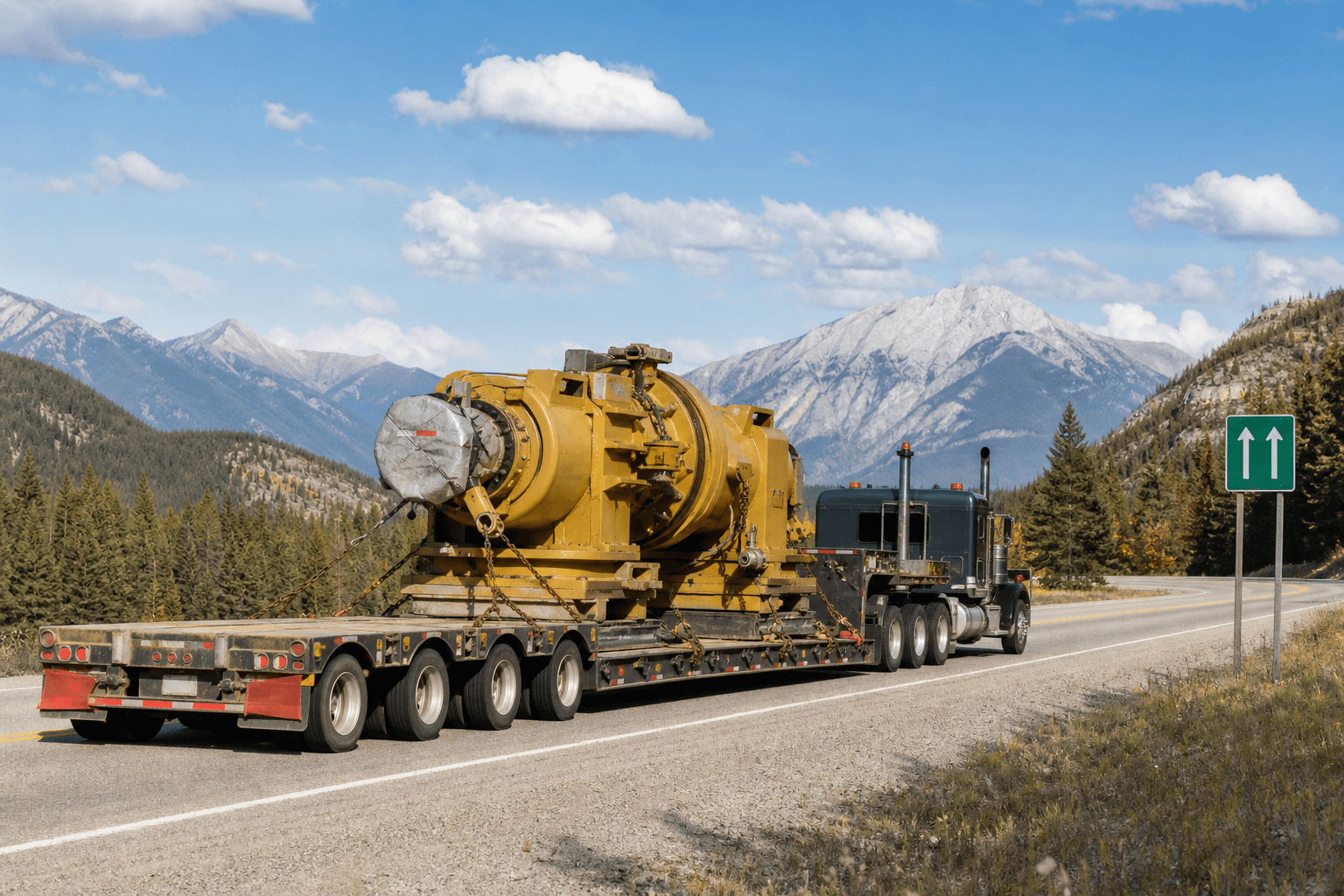
Before you book equipment or promise a delivery date for a heavy-haul shipment, confirm whether the loaded vehicle will exceed regulated weight or dimension limits. That decision affects equipment, routing, permits, escorts, delivery access, and coordination.
Alberta permits can authorize eligible oversized or overweight vehicles to travel under specific conditions, but requirements vary across Canada and the United States. Review Alberta's oversize and overweight permit requirements before dispatching a load.
Quick summary

- Measure the cargo as it will travel, including loaded height, width, length, and weight.
- Record the vehicle combination, axle configuration, origin, destination, and proposed route.
- Review bridges, utilities, road restrictions, delivery access, and jurisdiction changes early.
- Confirm who handles applications, route review, escorts, and permit-condition handoff.
- Verify current requirements with the relevant authority or an experienced carrier.
First decision: could the load exceed legal limits?
Start with the loaded configuration, not the cargo's unladen specifications. A machine may fit a deck's length but exceed legal width after loading, or its total height may change because of loading orientation and support equipment.
Oversize concerns generally involve length, width, or height. Overweight concerns can involve total vehicle weight, axle weights, or distribution across the combination. Exact thresholds and conditions depend on the jurisdiction and vehicle configuration, so do not rely on an old shipment or another route.
Alberta states that commercial vehicles above regulated weight or dimension limits may require commercial transportation permits. Check Alberta's current commercial transportation permit information when Alberta is part of the movement.
Mistake 1: Using estimates instead of verified load information

An estimate suitable for an initial quote may be unsuitable for an application, route review, equipment decision, or driver instruction. Small errors can change the permit classification or make a planned route impractical.
Prepare measured cargo length, width, height, and weight; total loaded dimensions including supports and securement equipment; cargo details; loading limitations; truck, trailer, and axle information; pickup and delivery addresses; and any site restrictions.
Ask who rechecks the dimensions before dispatch and how changes will be handled. If the cargo is remeasured, repacked, or loaded differently, the original routing and permit assumptions may need review.
Mistake 2: Applying before reviewing the complete route
A permit is part of a route decision, not a replacement for route planning. A route that works on a map may be unsuitable because of bridge limits, construction, seasonal conditions, restricted roads, urban access, or a delivery site that cannot accommodate the vehicle.
Review the complete movement, including the first and last kilometres. Confirm where the vehicle can turn, stop, stage, and enter the property, and whether the site requires a scheduled delivery window.
Alberta describes its High Load Corridor as designated highways designed to accommodate high loads under specific conditions. It is a useful planning reference, but it does not remove the need to verify the actual route, clearance, restrictions, and destination access. See Alberta's current corridor information during route planning.
Mistake 3: Treating height as only a roadside measurement
Total loaded height must be assessed against every relevant overhead constraint. Bridges are only one consideration. Utilities, signs, traffic signals, rail crossings, temporary structures, tree cover, and the receiving site's entrance can all affect a move.
Confirm how the cargo will sit on the trailer, whether its orientation can change, and who verifies the final height after securement. Ask how route conditions are checked and what happens if a field measurement differs from the planning information.
Alberta's High Load Corridor includes highways with raised or buried utilities intended to accommodate high loads up to stated limits, subject to exceptions and conditions. Treat those capabilities as planning information, not blanket clearance for an individual shipment.
Mistake 4: Assuming one Alberta permit covers the entire trip
A cross-border or interprovincial move may pass through several regulatory jurisdictions. An Alberta permit does not automatically establish requirements for British Columbia, Saskatchewan, another province, or a U.S. state.
Make a jurisdiction list before booking. For each province, state, or local authority, confirm applications, routing, operating hours, escorts, pilot vehicles, documentation, and local coordination. Also ask whether the route may change after an application is submitted.
A move that is legal under one jurisdiction's conditions may need additional approvals or different operating conditions after crossing a border. Agree who checks each jurisdiction and where current documents will be kept.
How Alberta's TRAVIS process fits into preparation
Alberta states that basic overweight, overdimension, and licensing permits are processed through TRAVIS, its automated permit system. Carriers can enter applications directly through the web system or use a TRAVIS agent.
Think of TRAVIS as Alberta's application and status channel, not a substitute for accurate information. Prepare loaded dimensions, weights, vehicle details, origin, destination, and route information first.
Alberta's permit process document explains the TRAVIS role, while TRAVIS Web provides current application and status access. Check live government information before submitting.
What to confirm about permit conditions and carrier responsibilities
Do not stop at asking whether a carrier can obtain a permit. Identify the work each party will perform and the conditions that must be satisfied before the vehicle moves.
- Who submits each provincial, state, local, or Alberta application?
- Who verifies the proposed route and checks changes before dispatch?
- Could escorts, pilot vehicles, signs, lighting, or restricted hours apply?
- How will permit conditions reach the driver and dispatch team?
- Who coordinates border documentation?
- What happens if dimensions, weight, pickup time, or the delivery address changes?
- Who confirms that the delivery site can receive the vehicle?
These questions do not assume a particular carrier performs every task. They establish ownership, handoffs, and escalation points before a delay becomes an active shipment problem.
Compare the main heavy-haul planning risks
| Concern | Verify | Potential issue | Question to ask |
|---|---|---|---|
| Oversize dimensions | Loaded length, width, and height | Wrong equipment or route assumption | Who verifies final measurements? |
| Overweight or axle distribution | Total weight, axles, and distribution | Restrictions or unsuitable equipment | Are weight details current? |
| Overhead clearance | Total height and route obstacles | Bridge, utility, or site conflict | How is clearance checked? |
| Route and infrastructure | Restrictions, construction, staging, and access | Rerouting or missed windows | Has the full route been reviewed? |
| Jurisdiction changes | Every province, state, and local authority | Missing approval or inconsistent conditions | Who confirms requirements beyond Alberta? |
| Carrier responsibilities | Applications, conditions, escorts, and documents | Unclear ownership | What must be complete before dispatch? |
Pre-booking checklist for an oversize or overweight shipment
- Cargo: Record verified dimensions, weight, description, orientation, and securement needs.
- Vehicle: Confirm the truck, trailer, combination, axle details, and loaded configuration.
- Route: Identify local access roads, highways, staging locations, and restrictions.
- Permits: List every jurisdiction and confirm possible applications.
- Conditions: Ask about operating hours, escorts, pilot vehicles, signage, lighting, and route instructions.
- Site access: Confirm turning space, clearance, unloading equipment, appointments, and receiving constraints.
- Cross-border planning: Clarify who coordinates Canada–USA shipping and border documents.
- Contingencies: Agree on contacts and approvals if the load, route, weather, or timing changes.
- Staging: Ask whether storage or cross-docking fits the shipment plan.
Flying Falcon states that its Edmonton warehouse supports storage, loading, unloading, cross-docking, and distribution. Those services can support shipment handoffs, but they do not replace permit or route requirements.
Choosing a carrier after the permit questions are clear
Compare carriers on more than equipment or quoted rate. Look for a clear process for verifying dimensions, selecting equipment, reviewing routes, communicating conditions, and managing changes.
Flying Falcon Logistics Ltd is an asset-based Canadian flatbed and specialized freight carrier based in the Edmonton–Nisku area. Its verified services include wide-load flatbed transportation, long-haul and short-haul moves, hot-shot expedited freight, and specialized transportation for oversized cargo, machinery, oilfield equipment, and agricultural equipment.
After permit and route requirements are confirmed, long-haul flatbed transport can support oversized equipment movements across Canada and the United States. Ask the carrier to state exactly which permitting, routing, escort, and cross-border tasks it will handle.
Heavy haul permitting FAQ
Does every heavy or oversized load require a permit?
No. The need depends on legal weight and dimension limits, vehicle configuration, route, and jurisdiction. Assess the shipment against current local requirements.
Do Alberta heavy-haul permits apply in other provinces or the United States?
Not automatically. Each province, state, or local authority may impose its own permit, routing, operating, escort, and documentation requirements.
What information is needed before starting an Alberta TRAVIS application?
Prepare accurate loaded dimensions, weight, vehicle and axle details, cargo information, origin, destination, and route details. Confirm current requirements through Alberta.
Does the High Load Corridor eliminate route planning?
No. It is a planning reference for designated highways, but the specific load, route conditions, local roads, and delivery site still require review.
What should a shipper confirm with a carrier before booking?
Confirm who handles applications, route checks, permit-condition communication, escort questions, border coordination, site review, and changes before dispatch.
Verify the load before you commit to a dispatch date
A sound heavy-haul plan starts with verified dimensions, weight, vehicle details, and delivery information. Review the full route, separate Alberta requirements from those in every other jurisdiction, and make permit conditions and responsibilities explicit.
Do not let a familiar cargo type, previous permit, or straightforward-looking route replace current verification. Early questions about clearance, infrastructure, escorts, staging, and cross-border coordination can prevent avoidable changes.
For specialized freight involving wide loads, machinery, oilfield equipment, agricultural equipment, or flatbed transportation, discuss the shipment with Flying Falcon Logistics Ltd and request a quote based on the actual cargo, route, and timing.


