
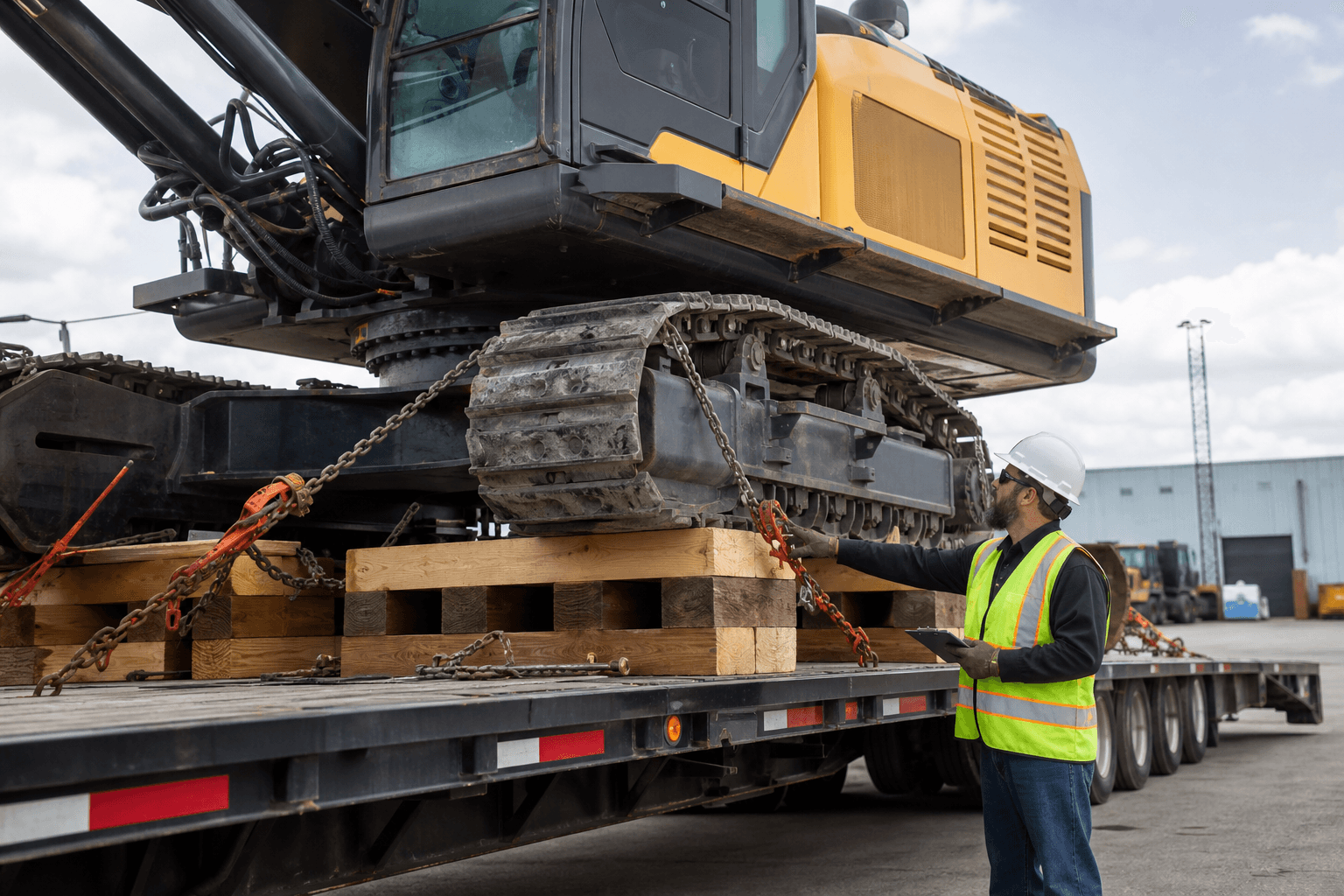
Heavy machinery transport cradling is the use of a purpose-selected support arrangement to help a machine rest securely and remain stable during loading, transit, and unloading. It may be useful when equipment has an uneven base, vulnerable components, unusual geometry, or a weight distribution that makes ordinary placement unsuitable.
Cradling is not a universal service or a substitute for professional load assessment. The right approach depends on the machine, its dimensions and weight, the loading conditions, the route, and the legal requirements that apply to the move. Flying Falcon Logistics Ltd verifies machinery and open-deck transportation, including heavy equipment, farm equipment, industrial generators, and oversized cargo, but each shipment still needs to be assessed individually.
What does transport cradling mean?
In practical terms, a transport cradle is a support arrangement that allows heavy machinery to sit in a stable, controlled position while it is moved. It can help distribute contact forces, protect vulnerable areas, and keep irregular equipment from resting directly on unsuitable points.
The word “cradle” describes the function of the support, not one standard piece of equipment. The appropriate arrangement may vary according to the machine’s frame, tracks, wheels, underside, attachments, lifting points, and center of gravity. A carrier or qualified loading professional must determine what support is suitable rather than applying a generic design to every machine.
For example, a machine with a flat, robust base may be suitable for ordinary open-deck loading after its dimensions and weight are reviewed. Another machine may have low ground clearance, a narrow contact area, detachable components, or a high center of gravity that requires more careful support and handling coordination.
Cradling, blocking, bracing, and securement are not the same

These terms are related, but they describe different parts of a transport plan:
- Cradling: supports the machine at appropriate resting points and helps accommodate its shape or vulnerable areas.
- Blocking: places barriers or supports to limit movement, such as rolling, sliding, or shifting.
- Bracing: adds resistance against movement or tipping in a particular direction.
- Load securement: uses approved methods, equipment, and procedures to restrain the cargo during transit.
A cradle may work alongside blocking, bracing, chains, straps, or other securement methods. It does not automatically make a load secure, and it does not remove the need to follow applicable cargo securement requirements. Alberta commercial carriers should consult the National Safety Code cargo securement guidance and other applicable transportation legislation before a move.
When might heavy machinery need specialized support?
There is no single weight or size at which every machine suddenly requires a cradle. Instead, look at the interaction between the equipment and the transport process.
- Unusual contact points: The machine may not have a stable, level base designed for trailer travel.
- Vulnerable components: Hydraulic lines, controls, wheels, tracks, outriggers, or other parts may need protection from concentrated pressure.
- High or uneven center of gravity: The machine may be more sensitive to movement, leaning, or changes in the road surface.
- Attachments and loose parts: Buckets, booms, blades, implements, or other attachments may need removal, folding, separate support, or additional securement.
- Limited lifting or loading points: The available equipment and loading method may affect how the machine can be positioned safely.
- Site conditions: Soft ground, slopes, narrow entrances, field access, ramps, overhead obstructions, and limited unloading space can change the plan.
Flying Falcon’s verified machinery transport experience includes local and linehaul moves for heavy equipment, farm equipment, industrial generators, and other specialized cargo. Its grain and agricultural machinery transport information also highlights that challenging equipment and off-road or field approaches require suitable planning. That does not mean every shipment needs cradling, nor does it confirm a cradle fabrication or installation service.
Choosing the transport plan for a cradled machine
Cradling concerns how the machine is supported. The transport category concerns whether the vehicle, route, and legal movement plan can accommodate the complete loaded shipment. These are separate decisions that must be considered together.
| Transport conversation | When to discuss it | Details that affect the decision |
|---|---|---|
| Standard open-deck or flatbed transport | The machine may fit within the carrier’s available equipment and applicable legal limits after assessment. | Loaded length, width, height, weight, axle distribution, support points, loading method, and delivery access. |
| Wide-load transportation | The loaded machine or its support arrangement may exceed ordinary width or other route limits. | Overall loaded dimensions, route restrictions, permits, pilot cars or escorts, overhead clearance, and travel timing. |
| Heavy-haul planning | The machine’s weight, axle loading, dimensions, or handling requirements create additional equipment and regulatory considerations. | Gross and axle weights, trailer configuration, bridge and road restrictions, permits, route survey needs, and loading resources. |
Do not assume that placing equipment in a cradle changes its transport classification. The relevant measurements are generally those of the complete loaded move, including the machine, supports, attachments, and transport equipment. Alberta’s commercial vehicle weight and dimension regulations explain why operators must confirm the requirements that apply to a particular movement.
For shipments that may exceed ordinary dimensions, review the carrier’s wide-load transportation planning early. Flying Falcon states that over-width loads may require permits, escorts, or pilot cars depending on the move, but the actual requirements depend on the jurisdiction, route, dimensions, and operating conditions.
Information to prepare before requesting a machinery transport quote
A detailed quote request helps a carrier evaluate equipment suitability, loading needs, route constraints, and potential compliance issues. Send as much of the following information as you can:
- Machine make, model, serial number, and a description of its purpose.
- Ready-to-transport weight, including fuel, fluids, attachments, support materials, and accessories.
- Overall length, width, and height in the configuration that will actually travel.
- Center of gravity or manufacturer handling information, if available.
- Photos of all sides, the underside, attachment points, wheels or tracks, and any damaged or vulnerable areas.
- Details of attachments that will remain installed, be removed, or travel separately.
- Known lifting points, loading points, ramps, or manufacturer instructions.
- Pickup and delivery addresses, including site contacts and access restrictions.
- Available loading and unloading equipment, such as ramps or customer-provided machinery.
- Required timing, border crossings, provincial routes, and whether the move is one-time or recurring.
If measurements are estimates, label them clearly. A small difference in height, width, or weight can affect equipment selection, permits, route planning, and the delivery-site plan.
Plan the loading, unloading, and delivery conditions
A transport quote is not complete if it considers only the highway portion. The carrier also needs to understand how the machine will leave its current location, how it will be loaded, and how it will be removed at delivery.
Confirm whether the pickup or delivery site has firm ground, suitable turning space, ramps, loading docks, overhead clearance, gates, slopes, or restricted access. If the machine must be moved through a field or other difficult approach, explain that before booking rather than assuming the driver can resolve it on arrival.
For agricultural equipment and related moves, you can review grain hopper and agricultural machinery transport as an example of why local conditions and equipment characteristics matter. The page describes challenging heavy machinery and cargo, including movements involving fields and other off-road terrain.
If the machine cannot move directly from pickup to delivery, ask whether interim storage, unloading, transfer, or cross-docking is needed. Flying Falcon verifies Edmonton-area warehousing, storage, loading, unloading, cross-docking, and distribution support for freight moving across Canada and the United States. These services may help coordinate a broader logistics plan, but they should not be treated as a substitute for specialized lifting or rigging unless separately confirmed.
Permits, route planning, and cargo securement
Machine dimensions and weight can affect whether the movement is legal on a proposed route. They may also affect the vehicle configuration, axle distribution, travel restrictions, permits, escorts, pilot cars, and delivery timing.
Requirements can change between provinces, states, and routes. Alberta’s commercial carrier resources identify applicable transportation legislation and cargo securement standards, while its weight and dimension regulations explain that limits are connected to infrastructure protection and road safety. Use those official resources as a starting point, then have the carrier confirm the requirements for the complete load and route.
Ask who is responsible for submitting permits, coordinating escorts, checking route restrictions, confirming clearances, and communicating changes. Also clarify what happens if the machine’s final measurements differ from the original quote request. Accurate information is important because a support arrangement, attachment, or loading position can change the loaded dimensions.
Questions to ask a carrier before booking
These questions can expose planning gaps before the machine is scheduled:
- What equipment appears suitable based on the machine’s loaded dimensions and weight?
- Who will assess the support arrangement, blocking, bracing, and load securement?
- Does the carrier need manufacturer drawings, lifting instructions, photos, or a site visit?
- Will the complete load require wide-load or heavy-haul planning?
- Who coordinates permits, route checks, escorts, and pilot cars if required?
- What must the shipper provide for loading and unloading?
- Are pickup and delivery surfaces, access roads, ramps, and turning areas suitable?
- How will the shipment be tracked, and who receives status updates?
- What documentation is required for condition checks, damage reporting, insurance, or delivery confirmation?
- How are changes handled if the machine, route, weather, or site conditions differ from the original plan?
A carrier’s answers should identify what is known, what still needs verification, and which responsibilities belong to the shipper, carrier, site operator, or another qualified professional.
Frequently asked questions
Does every heavy machine need a transport cradle?
No. Some machines can be positioned and secured using suitable standard loading methods. A cradle may be considered when the equipment has an irregular base, vulnerable components, unusual geometry, or stability concerns, but the decision must be made for the specific machine and move.
Does a transport cradle replace tie-downs and other load securement?
No. A cradle supports the machine, while blocking, bracing, tie-downs, and other methods may be needed to control movement. The complete arrangement must meet applicable cargo securement requirements.
Does using a cradle automatically make a shipment heavy haul?
No. Transport classification depends on the complete loaded dimensions, weight, axle distribution, equipment, and route. A cradle can affect the loaded height, width, or weight, so it should be included in the carrier’s assessment.
What information should I send when asking for a machinery transport quote?
Provide the machine’s make and model, ready-to-transport weight, loaded dimensions, attachments, photos, known handling points, pickup and delivery details, site conditions, desired timing, and route or border information. Include any manufacturer instructions or uncertainty in the measurements.
Who confirms whether permits or escorts are needed?
The carrier or transportation coordinator should review the complete load and route, but the shipper must provide accurate dimensions, weight, attachment, and site information. Requirements vary by jurisdiction and route, so confirm them before the move is scheduled.
Conclusion: confirm the support plan before the machine moves
Heavy machinery transport cradling is best understood as one part of a larger transport plan. It concerns how equipment is supported, while the carrier must also evaluate securement, vehicle suitability, loaded dimensions, weight distribution, route restrictions, permits, escorts, and site access.
Before requesting a quote, document the machine as it will actually travel, including attachments and support materials. Then ask the carrier to confirm whether the move fits standard open-deck transport or requires wide-load or heavy-haul planning, and clarify who is responsible for loading, unloading, compliance, and delivery coordination.
For machinery, open-deck, wide-load, agricultural, or related logistics requirements across Canada and the United States, request a quote from Flying Falcon Logistics Ltd with the complete equipment, route, and site details.


