
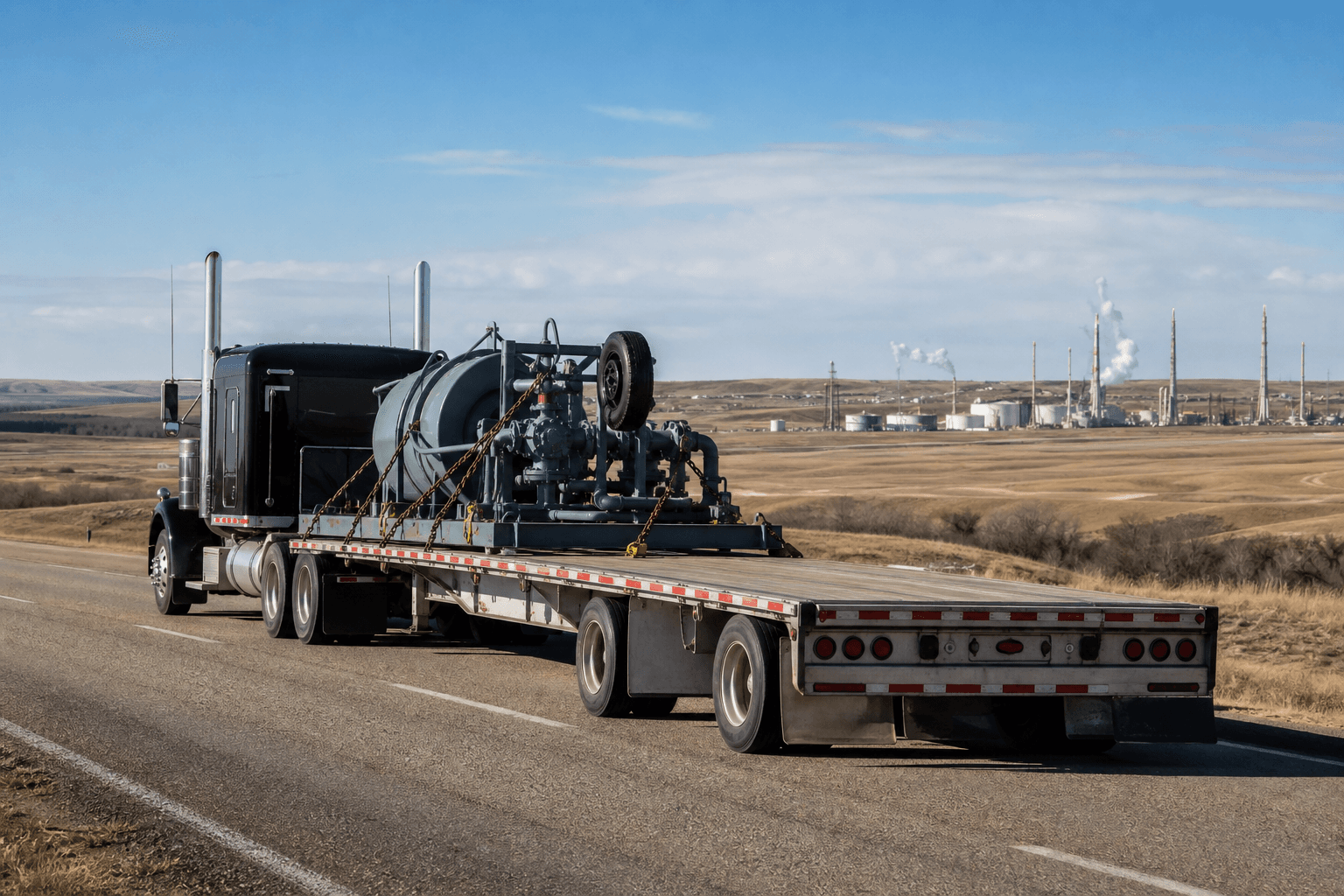
Oilfield equipment hauling safety depends on matching the transport plan to the load, not simply choosing the largest trailer or fastest service. The equipment's exact dimensions, weight, configuration, loading conditions, route, and delivery urgency determine whether standard flatbed, wide-load or heavy-haul, or hot-shot expedited transportation is appropriate.
Before requesting a quote, gather accurate shipment information and ask how the carrier will address securement, permits, route restrictions, loading responsibilities, insurance, and communication. Alberta guidance confirms that oversized or overweight moves may require permits with specific conditions, while cargo must be secured against shifting and damage.
Quick summary

- Standard flatbed: Often suits open-deck freight that fits applicable legal weight and dimension limits and has practical loading and securement points.
- Wide-load or heavy haul: Fits equipment whose size, weight, or configuration requires specialized planning, permits, route review, or equipment.
- Hot shot expedited: Addresses urgency, but does not replace equipment checks, securement planning, permit review, or route verification.
- Every option: Requires accurate measurements, weight, loading conditions, destination details, and a clear delivery window.
Flatbed vs heavy haul vs hot shot: what changes?
These labels describe different transportation requirements, not automatic levels of safety. A standard flatbed may suit one oilfield shipment, while another piece of equipment may need a wide-load plan because it exceeds applicable limits or creates unusual route and securement challenges.
Alberta describes oil and gas transportation as including equipment and supplies used in exploration, development, and production, including overweight and over-dimensional loads. A carrier's long-haul flatbed transportation option may suit open-deck freight moving over substantial distances, but the specific load still needs review.
| Option | Best fit | Main planning focus |
|---|---|---|
| Standard flatbed | Open-deck equipment within applicable legal limits | Trailer fit, loading access, weight distribution, and securement |
| Wide-load or heavy haul | Oversized, overweight, or unusually configured equipment | Permits, route, travel conditions, specialized equipment, and possible escorts |
| Hot shot expedited | Time-sensitive equipment that fits the selected vehicle | Urgency, dispatch coordination, route feasibility, and securement |
When standard flatbed transport fits

Standard flatbed transport may fit oilfield equipment that can be carried within applicable legal weight and dimension limits and has a stable configuration for open-deck hauling. It can accommodate irregularly shaped freight without the enclosed dimensions of a dry van, but open access does not eliminate careful loading and securement.
Confirm the proposed trailer, loading method, tie-down arrangement, and weight distribution. The carrier should understand where the equipment can be supported or secured, whether it has vulnerable components, and whether pickup and delivery sites can accommodate the vehicle.
Flying Falcon's supplied service information identifies oilfield equipment, heavy machinery, containers, and steel pipes among the freight it transports, with flatbed services for long-haul and short-haul moves across Canada and the United States. The specific equipment and route still require assessment before dispatch.
When wide-load or heavy-haul transport is necessary
Wide-load or heavy-haul planning becomes important when equipment exceeds applicable legal dimensions or weight limits, or when its shape, height, length, or weight distribution creates constraints a standard move cannot address. Do not rely on a generic threshold without checking the jurisdiction and complete vehicle-and-load combination.
Alberta states that oversize and overweight permits can include conditions for routes, travel times, equipment, and other safety requirements. Specialized equipment may also require a permit with specific conditions. Requirements can vary by province, state, route, and shipment, so confirm them for the complete journey.
Provide exact length, width, height, and weight in the intended transport configuration. Also identify the center of gravity, removable components, loading points, and attachments that change the dimensions. Flying Falcon's wide-load information emphasizes accurate weight and dimensions when planning equipment transportation.
Ask who will verify permits, route restrictions, travel windows, equipment requirements, and escort or pilot-car considerations. A carrier's ability to transport wide or heavy equipment does not mean every permit or escort arrangement is automatically included in a quotation.
When hot-shot expedited service makes sense
Hot shot is primarily an urgency and dispatch-planning choice. It may suit time-critical industrial machinery, plant equipment, or specialized freight when the proposed vehicle can legally and safely carry the load. Speed should never replace dimensional review, securement planning, or permit checks.
Flying Falcon states that its hot-shot service handles urgent freight such as industrial machinery and plant equipment and includes status tracking and dispatch support. Before accepting an expedited schedule, confirm cargo fit, pickup readiness, delivery access, route feasibility, and permit conditions that could affect timing.
Hot shot may be a poor fit when equipment is too wide, heavy, tall, or difficult to load for the proposed vehicle. A properly planned heavy-haul move may be more appropriate even if it requires additional preparation.
Shipment details to gather before requesting a quote
Accurate information helps a carrier propose suitable equipment and identify planning issues early. Prepare:
- Equipment type, make, model, condition, and clear description.
- Actual shipping weight, including attachments, fluids, accessories, and supports.
- Overall length, width, and height in transport configuration.
- Center of gravity, weight distribution, lifting points, tie-down points, and vulnerable components.
- Loading and unloading method, available machinery, ground conditions, yard access, and overhead obstructions.
- Pickup and delivery addresses, site restrictions, gate hours, and contacts.
- Required delivery window and urgency.
- Hazardous materials, fuel, batteries, or other regulated components.
- Destination provinces, states, and border crossings for Canada-US shipments.
Include photographs, drawings, or manufacturer specifications when possible. If measurements are estimates, label them clearly. A quote based on incomplete dimensions may not reflect the final equipment, permits, route, or securement requirements.
Cargo securement and loading safety
Securement is part of the safety chain from loading through unloading. Alberta guidance states that tie-downs and other securement devices must be strong enough for the cargo, with edge protection where a tie-down may experience wear, cutting, or crushing.
Position equipment for stability and appropriate weight distribution, using securement points suited to its structure. The plan should account for movement during braking, turning, uneven surfaces, and changing road conditions. Alberta workplace guidance also emphasizes securing loads so they cannot shift and endanger workers.
Confirm responsibilities in writing. Ask whether the shipper, site crew, carrier, crane operator, or another contractor handles loading, rigging, blocking, tie-downs, inspections, and unloading. Do not assume the carrier performs every activity simply because it arranges transportation.
Permits, route planning, and carrier checks
Review the route after classifying the equipment. An oversize or overweight permit may specify approved roads, travel times, vehicle conditions, and other restrictions. Bridges, construction, narrow access, seasonal restrictions, or local site conditions can make a route unsuitable for a tall, wide, or heavy load.
For Alberta operations, ask about commercial operating requirements, vehicle inspections, safety-fitness status, operating authority, and fatigue-management procedures. For Canada-US moves, confirm how the carrier will coordinate the full route and border requirements.
Request a written explanation of what the quote includes. It should identify the proposed transport type, assumptions about dimensions and weight, permit responsibilities, accessorial charges, loading and unloading roles, tracking, and the process for changes to the load or route.
Questions to ask before choosing a carrier
- Have you transported comparable oilfield equipment?
- What vehicle or trailer do you propose, and why does it fit?
- Have you reviewed the complete dimensions, weight, center of gravity, and loading points?
- Who handles permits, route review, escorts, and permit conditions?
- How will securement requirements and edge protection be addressed?
- Who performs loading, blocking, rigging, inspections, and unloading?
- What insurance coverage applies, and what exclusions or documentation requirements exist?
- How will dispatch communicate pickup, status, delays, route changes, or delivery issues?
- What assumptions would change the quote or require a different plan?
Pre-dispatch safety checklist
- Confirm the equipment description, final weight, and transport dimensions.
- Classify the move as standard flatbed, wide-load or heavy haul, expedited, or a combination requiring review.
- Confirm the vehicle, loading method, securement points, weight distribution, and edge protection needs.
- Review permits, approved routes, travel windows, equipment conditions, and escort needs.
- Verify pickup and delivery access, ground conditions, overhead clearance, and loading equipment.
- Assign loading, rigging, securement inspection, and unloading responsibilities.
- Document insurance, tracking, dispatch contacts, and escalation procedures.
- Obtain quote assumptions and exclusions in writing.
Frequently asked questions
Does oilfield equipment always require heavy-haul transportation?
No. Some equipment may fit a standard flatbed when its weight, dimensions, configuration, and route remain within applicable requirements. Heavy haul becomes relevant when the load is oversized, overweight, unusually configured, or requires specialized planning.
When might an oversize or overweight permit be required in Alberta?
A permit may be required when the vehicle and load exceed applicable legal weight or dimension limits. Conditions can address routes, travel times, equipment, and other requirements. Confirm current rules for the specific load, vehicle, route, and jurisdiction.
Is hot-shot service suitable for oversized oilfield equipment?
Only if the proposed equipment, route, permits, securement plan, and delivery conditions support the move. Hot shot addresses urgency, not the underlying dimensional or weight requirements.
Who is responsible for securing equipment on a flatbed?
Responsibilities depend on the agreement and site roles. Confirm who handles loading, blocking, rigging, tie-downs, inspections, and unloading before dispatch.
Conclusion: match the transport plan to the equipment
The safest oilfield equipment hauling decision is not automatically standard flatbed, heavy haul, or hot shot. Standard flatbed may fit legally dimensioned open-deck equipment, wide-load or heavy-haul service may be necessary for oversized or overweight freight, and hot shot may fit urgent cargo when the equipment and route support expedited planning.
Document the equipment's measurements, weight, configuration, loading conditions, destination, and delivery window. Then ask the carrier to explain the vehicle, securement approach, permits, route, responsibilities, insurance, and communication plan.
Flying Falcon Logistics Ltd is an Edmonton-area asset-based carrier offering flatbed, oilfield equipment, wide-load, and hot-shot expedited transportation across Canada and the United States. Prepare your shipment details with Flying Falcon Logistics Ltd.


