
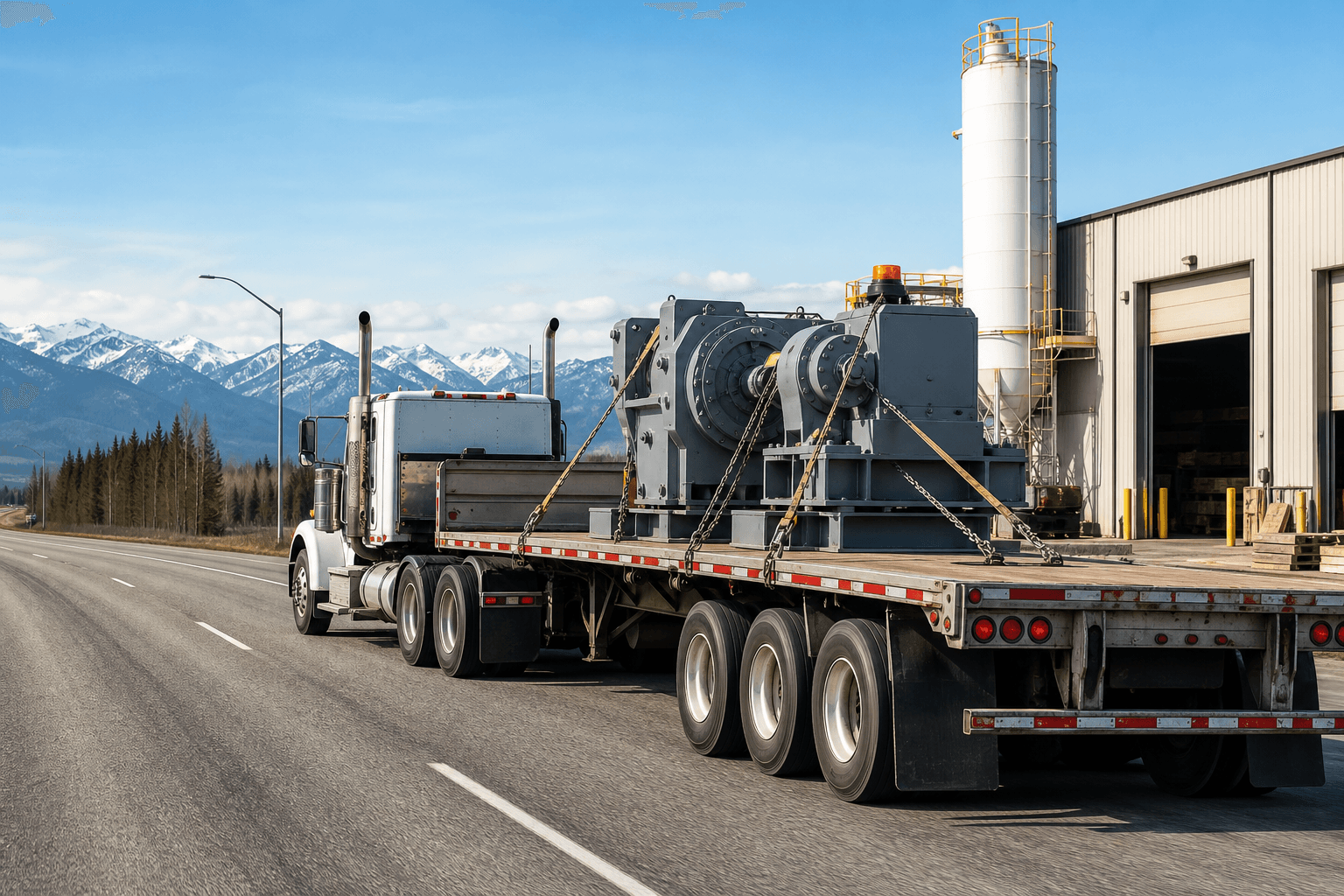
Short-haul transportation efficiency is not simply a matter of choosing the fastest truck. It depends on matching the freight, equipment, route, pickup plan, delivery window, and handling requirements before the shipment moves. A slightly longer direct trip can be more efficient than a faster-looking plan involving unsuitable equipment, avoidable transfers, or unplanned storage.
For shippers in Alberta, British Columbia, Saskatchewan, and nearby markets, the right decision may be direct flatbed transport, LTL shipping, cross-docking, temporary warehousing, or hot shot expedited service. The best option is the one that meets the shipment's needs with the fewest unnecessary complications.
What short-haul transportation efficiency actually means
Efficient regional freight movement usually means reducing wasted time, handling, storage, trips, and communication gaps while keeping the shipment safe and properly matched to the equipment. It also means setting a delivery window that reflects the route, receiving site, loading conditions, and special requirements.
Speed is only one part of the decision. A direct open-deck move may avoid a transfer and reduce the chance of damage or missed handoffs, even if another option appears faster on an individual route segment. Conversely, consolidating compatible freight through LTL or cross-docking may reduce separate trips when inbound and outbound schedules are properly coordinated.
Route planning should account for actual site access rather than relying on distance alone. Alberta's official 511 service lets users enter trip locations, review generated routes, and select a suitable route. Reviewing a proposed route through Alberta 511 does not replace carrier planning, but it gives the shipper a useful starting point.
Planning mistakes that commonly reduce freight efficiency

Providing incomplete cargo details
A quote based on a vague description such as “machinery” or “steel” may not reflect the actual equipment, loading method, or route requirements. Dimensions, weight, shape, center of gravity, packaging, loading points, and whether the freight can be loaded from the side or rear can all affect the plan.
Include the number of pieces, exact measurements, total weight, lifting or loading equipment available at each end, and whether the freight can be loaded and secured on an open deck. Accurate information helps the carrier assess equipment suitability and reduces last-minute changes.
Choosing equipment before understanding the freight
Flatbed transport is useful for freight that is difficult to load into an enclosed trailer or benefits from open-deck access. It is not automatically the right choice for every regional shipment. Equipment must suit the cargo's length, width, height, weight distribution, loading method, and securement needs.
Flying Falcon's short-haul service information identifies cargo such as steel-related products, oilfield equipment, oversized cargo, heavy farm equipment, industrial generators, automobiles, and other specialized freight. Businesses comparing regional delivery options can evaluate short-haul flatbed transport when the shipment requires open-deck access across Alberta, British Columbia, or Saskatchewan.
Treating pickup coordination as an afterthought
A truck cannot improve an unprepared loading site. Confirm whether the origin has a dock, crane, forklift, loading crew, scale, staging area, or restrictions on truck access. Also confirm who is responsible for preparing the freight and whether the carrier must wait for loading.
At delivery, verify receiving hours, appointment requirements, unloading equipment, site clearance, and where the truck should report. A shipment can be physically close to its destination and still lose time if the receiving team is unavailable or the vehicle cannot access the site.
Promising a delivery window without checking the route
A short distance does not guarantee a short operational cycle. Construction, seasonal road conditions, restricted access, urban delivery windows, rural approaches, border processes, and loading delays can all affect the schedule. Ask how the proposed delivery window accounts for these factors instead of treating drive time as a complete delivery plan.
Adding transfers or storage without a clear reason
Every transfer creates another handoff, staging requirement, and opportunity for freight to be delayed or mishandled. Cross-docking and temporary warehousing can be useful, but they should solve a specific coordination problem rather than compensate for incomplete planning.
Which short-haul freight option fits the shipment?
The most efficient service depends on urgency, freight characteristics, volume, delivery pattern, and tolerance for additional handling. Use the comparison below as a starting point, then confirm the details with the carrier.
| Option | Often fits when | Efficiency advantage | Key risk to check |
|---|---|---|---|
| Direct short-haul flatbed | Freight needs open-deck access or is industrial, oversized, or irregular | Fewer transfers and a simpler origin-to-destination plan | Equipment, loading access, securement, and route suitability |
| LTL shipping | The shipment does not require a full truck and can move through a shared network | Consolidates smaller shipments and may avoid booking unused capacity | Additional handling, terminal timing, labeling, and delivery coordination |
| Cross-docking | Inbound freight can be transferred quickly to an outbound vehicle or consolidated load | Can reduce storage, handling time, and separate trips when synchronized | Accurate quantities, labels, arrival times, and outbound instructions |
| Warehousing and logistics | Freight needs staging, temporary storage, order coordination, or multiple delivery dates | Creates flexibility between inbound supply and outbound demand | Storage duration, inventory control, handling responsibility, and added touches |
| Hot shot expedited | The shipment is time-sensitive and delay costs justify a faster dedicated response | Prioritizes urgent movement instead of waiting for a regular cycle | Availability, realistic timing, cargo readiness, and route constraints |
When direct short-haul flatbed transport is the simpler choice
Direct transport is often worth considering when the cargo is difficult to reload, vulnerable to handling, ready at the origin, and going to one destination. This can include steel products, containers, oilfield equipment, heavy machinery, farm equipment, and other freight that benefits from open-deck loading.
The decision becomes less straightforward when the load is small, several shipments share a destination area, or delivery must be staged over multiple dates. In those cases, LTL, consolidation, or warehousing may make better operational sense. The important question is not whether direct transport sounds faster. It is whether it removes enough handling and coordination to justify the arrangement.
For regional shipments involving machinery or industrial freight, short-haul flatbed services can be evaluated alongside LTL, expedited, warehousing, and logistics options. Ask the carrier to explain which service assumptions are included in the quote and which depend on site readiness or special requirements.
When LTL, cross-docking, or warehousing may improve the flow
LTL shipping can be appropriate when the freight is smaller than a full load and can tolerate the additional coordination associated with shared transportation. Provide clear piece counts, dimensions, weight, handling instructions, labels, and delivery requirements so the shipment can be planned accurately.
Cross-docking can reduce material handling and warehouse storage when inbound and outbound movements are synchronized. Flying Falcon describes cross-docking as a process in which freight may remain at a facility for only a few hours, with inbound and outbound sides coordinated to move products through quickly. It can also support consolidation into fuller loads and reduce separate trips.
However, cross-docking is not automatically efficient. A late inbound truck, incomplete paperwork, mismatched quantities, unclear labeling, or an unavailable outbound vehicle can turn a fast transfer into storage and extra handling. Confirm arrival times, transfer instructions, labeling standards, responsible contacts, and what happens if the schedule changes.
Warehousing may be better when inventory needs to be staged between production, construction, distribution, or delivery appointments. Clarify how long the freight may remain stored, whether it requires special handling, how it will be identified, and whether the warehouse is being used for storage, consolidation, or a planned sequence of deliveries.
Check route, site access, and delivery constraints before booking
Ask the carrier to review more than the origin and destination postal codes. Share gate locations, low clearances, narrow roads, weight restrictions, seasonal access concerns, construction areas, appointment windows, and any requirement for a specific loading or unloading direction.
For Alberta freight, provincial transportation information provides context on commercial transportation systems and carrier requirements. Route conditions and economic corridors can change the practical choice between a direct movement and a transfer-based plan, particularly for industrial or rural deliveries. Confirm the route with the carrier rather than assuming the shortest map route is suitable for the equipment.
Do not treat oversized freight like a standard shipment
Wide-load and heavy-haul planning should begin with accurate dimensions and weight, not after a truck has been assigned. Confirm the overall loaded width, height, length, axle or weight considerations, loading method, destination access, and whether the cargo can be adjusted or disassembled.
Depending on the shipment and jurisdiction, wide-load transportation may involve permits, escorts, pilot cars, route restrictions, or specific travel conditions. Flying Falcon's wide-load information notes that permits and escorts or pilot cars may be required. Ask the carrier and relevant authorities which requirements apply, who is responsible for arranging them, and whether their cost and timing are included in the quotation.
Do not assume requirements are identical in Alberta, British Columbia, Saskatchewan, or across the Canada-US border. Alberta's commercial-carrier resources emphasize the importance of safety management and compliance with applicable transportation rules. The carrier should explain the planning assumptions without presenting a general statement as shipment-specific approval.
Short-haul transportation pre-booking checklist
- Locations: Full pickup and delivery addresses, site contacts, gate instructions, and receiving hours.
- Freight description: Cargo type, number of pieces, packaging, value if relevant, and whether it is fragile, hazardous, or difficult to handle.
- Measurements: Exact length, width, height, weight, and loaded dimensions for each piece.
- Equipment: Available cranes, forklifts, docks, ramps, loading crews, and unloading equipment at both ends.
- Timing: Cargo-ready date, pickup window, delivery window, appointment rules, and consequences of delay.
- Access: Road restrictions, low clearances, narrow entrances, rural approaches, construction, and seasonal limitations.
- Handling plan: Whether the freight must move direct, may be transferred, needs consolidation, or requires temporary storage.
- Oversize requirements: Permit, escort, pilot-car, route-review, and responsibility questions.
- Communication: Dispatch contact, shipment updates, proof-of-delivery process, and escalation contact if conditions change.
Questions to ask before choosing a regional carrier
- What equipment is being considered, and why does it fit this freight?
- Will the shipment move directly, through LTL, through a cross-dock, or through storage?
- What details could change the quote, schedule, or equipment requirement?
- What must be ready at pickup and delivery before the truck arrives?
- How will delays, route changes, missed appointments, or site-access problems be communicated?
- Does the shipment require permits, escorts, pilot cars, special securement, or a route review?
- What insurance and cargo documentation apply to this shipment?
- Which services are included in the quote, and which responsibilities remain with the shipper?
Frequently asked questions
When is short-haul flatbed transport more efficient than LTL shipping?
It may be more efficient when the freight needs open-deck access, is oversized or irregular, is difficult to reload, or is ready for a direct move to one destination. LTL may be more suitable when the shipment is smaller and can tolerate shared-network handling and consolidation.
Can cross-docking reduce short-haul freight handling and storage?
Yes, when inbound and outbound schedules, quantities, labels, and transfer instructions are accurate. Cross-docking can reduce storage and move freight through a facility quickly, but poor coordination can create extra handling instead of removing it.
What information does a carrier need to quote specialized regional freight?
Provide exact origin and destination details, cargo type, piece count, dimensions, weight, loading and unloading equipment, access restrictions, timing, handling requirements, and any oversize or special-compliance concerns. Complete information is more useful than a general cargo description.
What should shippers confirm before arranging wide-load transportation?
Confirm loaded dimensions, weight, route suitability, permits, escorts, pilot-car requirements, site access, travel restrictions, and who will arrange each requirement. These details can vary by shipment and jurisdiction, so they should be reviewed before the booking is finalized.
Conclusion: Choose the least complicated plan that fits the freight
Short-haul transportation efficiency comes from removing avoidable complexity, not from choosing the fastest-sounding service. Start with accurate cargo details, then compare direct flatbed transport, LTL, cross-docking, warehousing, and hot shot expedited service according to the freight, route, timing, and handling plan.
Before booking, make sure the carrier understands site access, loading readiness, receiving conditions, delivery expectations, and any oversized-load requirements. A clear plan gives both sides a better basis for evaluating equipment, transfers, schedule assumptions, and quote responsibilities.
For regional open-deck freight planning across Western Canada, contact Flying Falcon Logistics Ltd to discuss the shipment details and request a freight quote.


