
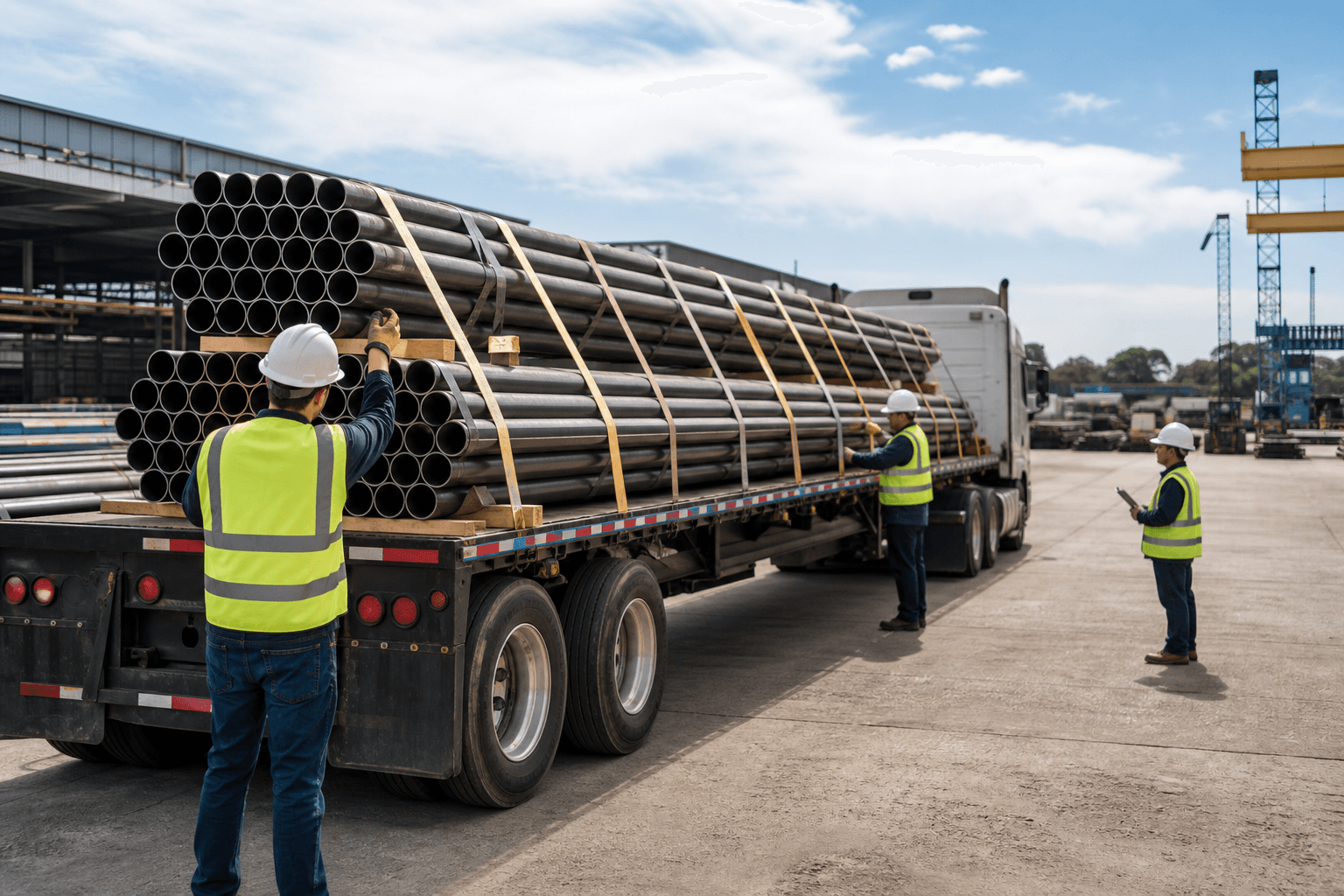
Steel pipe transport handling is more than placing pipe on a trailer and sending it to the next site. A safer shipment connects cargo documentation, site preparation, lifting, securement, route planning, unloading, and storage.
The shipper, carrier, loading crew, and receiving team should agree on responsibilities before the truck arrives. Exact lifting capacities, securement methods, trailer limits, permits, and route requirements must be confirmed for the specific shipment by qualified personnel and the responsible authorities.
Step 1: Document the pipe before requesting transport
Start with a complete load description. Record the number of pieces, lengths, outside dimensions, individual and total weights, bundles, end protection, coating, packaging, and whether the pipe is new, used, or prepared for a particular project.
Include the origin and destination, site contacts, pickup window, delivery appointment, border crossing if applicable, and whether the movement will use one leg or an intermediate facility. Photos, drawings, packing lists, and manufacturer handling instructions can clarify details that are difficult to explain by phone.
Pipe movement may include pickup, hauling, unloading, stringing, handling, safekeeping, and storage. Treat these activities as one chain rather than separate tasks.
Stop point: Do not schedule pickup while a critical dimension, weight, bundle configuration, or site condition is uncertain. Resolve missing information before the carrier finalizes the plan.
Step 2: Confirm loading and unloading conditions

Review both sites from a transport perspective. Confirm access, ground conditions, turning space, overhead obstructions, staging areas, appointment rules, and restrictions on truck size or operating hours.
Establish who supplies and operates lifting equipment. Alberta guidance notes that loading and unloading may involve forklifts or cranes, and drivers should not operate lifting equipment or rig loads unless qualified through training and experience. Review the Alberta guidance on securing pipe and other cargo when assigning responsibilities.
Government of Canada guidance warns that unstable freight, including pipe, can fall from a flatbed and cause serious injury. The loading crew should control the work area, follow the lifting plan, and keep people clear of suspended or unstable loads.
Stop point: Pause the booking if the site lacks suitable equipment, qualified operators, safe staging space, or a receiving team.
Step 3: Match the shipment to the transport service
Choose the service after the cargo and site information is known. Standard open-deck flatbed transport may suit pipe that fits applicable dimensional, weight, route, and securement requirements. Short-haul or long-haul service depends on the route and delivery plan.
Unusual dimensions, weight, or route constraints may call for specialized planning or wide-load transportation. Time-sensitive projects may justify hot-shot expedited service. Smaller or consolidated freight may warrant an LTL assessment, while cross-docking or warehousing can support an intermediate transfer or storage plan.
| Option | May fit when | Confirm first |
|---|---|---|
| Standard flatbed | The pipe fits ordinary load and route requirements. | Dimensions, weight, supports, securement, and access. |
| Specialized or wide-load | The loaded shipment creates unusual dimensions or route constraints. | Loaded measurements, permits, escorts, pilot cars, and route restrictions. |
| Hot-shot expedited | The move is time-sensitive. | Availability, site readiness, and appointment consequences. |
| LTL | The freight does not require a full trailer and suits the carrier's process. | Piece size, packaging, weight, handling points, and damage risks. |
| Cross-docking or warehousing | The final site needs an intermediate transfer or storage plan. | Equipment, dwell time, inventory control, and next-leg scheduling. |
Step 4: Review route, dimensions, and permits
Review the route using actual loaded dimensions, not only the pipe's measurements on paper. Consider total width, height, length, weight distribution, turning requirements, bridge or road restrictions, border procedures, seasonal limitations, and access to the final site.
Oversize shipments may require permits and, where applicable, escorts or pilot cars. Requirements vary by province, state, route, and configuration.
Stop point: Identify who confirms permits, route approvals, escorts, and operating conditions. Do not dispatch on the assumption that another party has completed the review.
Step 5: Agree on loading and securement
The shipper, carrier, and loading crew should agree on the load pattern before loading begins. Discuss supports, separation, blocking, rolling prevention, trailer positioning, and differences between bundled and individual pieces.
Alberta guidance emphasizes supplier load patterns and methods that prevent equipment and materials from moving during transport. The final securement method must account for the cargo, trailer, supports, equipment, applicable rules, and qualified supervision.
Avoid relying on generic tie-down counts or trailer assumptions. Agree on who performs the final inspection and how changes to the load pattern will be approved.
Stop point: If the load cannot be positioned as planned or available equipment is unsuitable, stop and reassess. Do not improvise supports or move people into an unsafe area.
Step 6: Protect the pipe during handling and transit
Damage can occur during lifting, staging, loading, transit, unloading, or storage. Follow the manufacturer's written instructions, particularly where galvanized or other protective coatings could be damaged. Alberta specifications direct that pipe be handled and stored according to those instructions.
Use suitable supports and protective materials approved for the pipe and its coating. Avoid dragging, uncontrolled rolling, dropping, or contact with damaging surfaces where prohibited. The receiving team should know how to document visible damage or discrepancies.
Transport coordination is different from coating inspection or engineering approval. The shipper, manufacturer, engineer, or qualified site team must define special coating, fabrication, testing, or project requirements.
Step 7: Coordinate delivery, storage, or cross-docking
Specify the receiving contact, appointment, access route, unloading sequence, equipment, staging area, and inspection process. If the final site is not ready, decide whether pipe will be held, transferred, or delivered in a later leg.
Cross-docking can support a coordinated transfer between transport legs. Warehousing may be more suitable when the pipe needs controlled storage or the delivery schedule is uncertain. Confirm identification, supports, protection, inspection, and release procedures for the next movement.
For Edmonton-area coordination, a carrier that combines open-deck transportation with local flatbed transport services can discuss the relationship between pickup, delivery, storage, and the next leg.
Steel pipe transport pre-shipment checklist
- Cargo: Quantity, lengths, diameters, weights, bundles, packaging, coating, end protection, and instructions.
- Sites: Addresses, contacts, access, ground conditions, staging space, appointments, and lifting equipment.
- Responsibilities: Shipper, carrier, site supervisor, operators, rigging personnel, and receiving team.
- Transport: Equipment type, route, border details, urgency, LTL suitability, and storage needs.
- Compliance: Loaded dimensions, route restrictions, permits, escorts, pilot cars, and jurisdictional requirements.
- Securement: Load pattern, supports, blocking, separation, inspection points, and change procedures.
- Documentation: Packing list, photos, drawings, handling instructions, delivery records, and damage reporting process.
Final stop point: Resolve anything affecting safety, equipment, routing, or receiving before scheduling pickup.
What to include in a freight assessment request
Send the carrier the origin and destination, pipe inventory, dimensions and weights, photos or drawings, loading and unloading conditions, delivery window, border information, lifting arrangements, and storage or cross-docking needs. Identify whether the shipment may be oversized and who supervises lifting and rigging.
Frequently asked questions
Who is responsible for loading and unloading steel pipe?
Responsibility should be agreed before booking. The site commonly coordinates equipment, operators, rigging, and supervision, while the carrier coordinates trailer and transport requirements. Drivers should not perform lifting or rigging without appropriate qualifications.
When might steel pipe require wide-load transportation?
Specialized planning may be needed when the loaded shipment creates unusual width, height, length, weight, or route constraints. Confirm measurements and applicable provincial or state requirements, including permits and escorts.
Can steel pipe be stored or cross-docked between legs?
It may be possible with a suitable facility, handling equipment, supports, inventory control, and a defined next-leg schedule. Manufacturer storage instructions still apply.
Is LTL suitable for every steel pipe shipment?
No. Suitability depends on dimensions, weight, packaging, handling points, securement, and the carrier's LTL process. Long, heavy, bundled, or unusual pipe may require another option.
What information is needed for a steel pipe transport quote?
Provide origin, destination, quantity, dimensions, weights, bundle details, coating, timing, site conditions, route or border information, lifting arrangements, and storage needs.
Conclusion: Confirm the chain before the pipe moves
Reliable steel pipe transport handling begins before the truck arrives. Document the cargo, prepare both sites, assign qualified lifting responsibilities, agree on securement, review loaded dimensions and routing, protect the pipe, and plan delivery or storage as one operation.
Flying Falcon Logistics Ltd is an asset-based Canadian flatbed and specialized freight carrier established in 2013, with verified experience transporting steel pipes and supporting short-haul, long-haul, open-deck, wide-load, and logistics movements across Canada and the United States. Share your shipment details with Flying Falcon Logistics Ltd to assess suitable transport and coordination options before pickup.


