
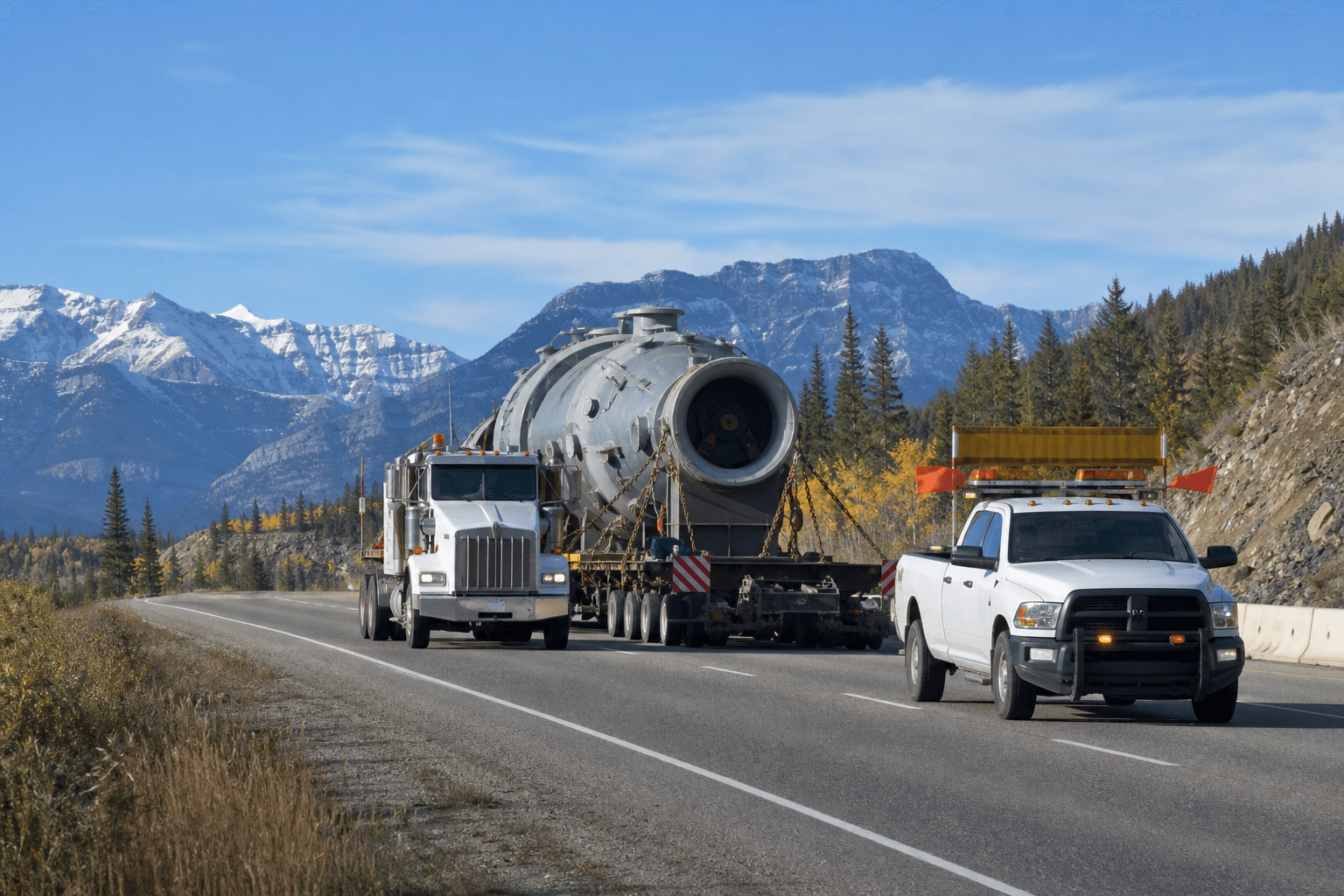
Wide-load transportation escort requirements in Alberta are not determined by width alone. The correct planning decision depends on the shipment's exact length, width, height, weight, axle configuration, route, road type, travel date, and the conditions attached to any required permit.
For shippers, the practical question is not simply whether a load is wide. It is which permissions and safety arrangements are required for this specific movement, and who will confirm them before the truck travels on a public road.
Quick summary

- An oversize or overweight permit and a pilot or escort vehicle are separate requirements.
- Alberta's official guidance includes a specific example for loads over 3.85 metres wide, but the complete requirement depends on the road and movement conditions.
- Route, infrastructure, travel timing, provincial or state boundaries, and border crossings can change the planning requirements.
- Before requesting a quote, collect exact cargo dimensions, weight, loading details, origin, destination, and preferred travel dates.
- Confirm in writing who is responsible for permits, escort coordination, route review, communication, and contingency planning.
Permit requirements and escort requirements are not the same
A wide, oversize, or over-dimensional load exceeds one or more standard legal limits for vehicle size or cargo dimensions. An overweight load exceeds an applicable weight limit. A shipment can be wide, tall, long, heavy, or affected by more than one of these conditions at the same time.
Alberta sets maximum commercial-vehicle weight and dimension limits. Loads that exceed those limits may be eligible to move under an oversize or overweight permit if the permit requirements are met. The permit is an authorization subject to conditions. It does not automatically mean that an escort vehicle is required, and it does not replace other route or safety checks. Review Alberta's current oversize and overweight permit requirements before treating a load as ready to move.
A pilot vehicle or escort vehicle is a separate part of the movement plan. Its role may include improving visibility, warning other road users, and supporting safe passage through particular road conditions. Whether one is required can depend on dimensions, road classification, direction of travel, permit conditions, and the route selected.
Do not assume that a load is legal, permit-ready, or escort-free because its width appears close to a familiar threshold. Height, length, weight, axle spacing, bridges, overhead structures, construction, and turning conditions can all affect the movement.
What Alberta's 3.85-metre example tells shippers

Alberta's weights and dimensions guidance gives a useful example for understanding why road type matters. For a load over 3.85 metres wide, the guidance states that a pilot vehicle may be required. It describes one pilot-vehicle position behind the load when traveling on a four-lane road, and one in front when traveling on a two-lane road. See the Alberta manual's weights and dimensions example for the stated conditions.
The same excerpt identifies movement restrictions for that example, including limits from 3:00 p.m. until midnight on a Friday or the day before a statutory holiday, and no movement on a Sunday or statutory holiday. These details show why a route and schedule must be reviewed together. They should not be treated as a complete summary of every current escort rule, permit condition, or load category.
In practice, use the 3.85-metre reference as a prompt to verify the movement, not as a universal answer. Confirm the current requirement for the actual dimensions, road type, direction, route, date, and permit issued for the shipment.
Why the route matters as much as the load
The same freight may face different planning requirements on different roads. A route can include two-lane highways, divided four-lane roads, urban streets, bridges, narrow approaches, construction zones, steep grades, or sections with limited shoulder space. Those conditions can influence pilot-vehicle positioning, travel timing, route selection, and whether the proposed route is practical at all.
Route planning also becomes more complex when a shipment crosses provincial or national boundaries. Alberta requirements should not be assumed to apply unchanged in British Columbia, Saskatchewan, another province, or the United States. Each jurisdiction may have its own permit process, escort terminology, operating restrictions, and documentation requirements.
For a move across provinces or the Canada-US border, use long-haul flatbed transport planning as a distinct workstream rather than adding it after the truck is booked. A specialized carrier should be given enough time to review the complete route, identify jurisdiction changes, and clarify which party handles each approval or coordination task.
Load details to collect before requesting a quote
A carrier cannot reliably assess a wide-load movement from a general description such as “large equipment.” Prepare a complete load profile before requesting a quote or asking whether escorts are needed.
- Exact dimensions: Record the loaded length, width, and height, including the trailer, supports, packaging, attachments, and any removable or raised components.
- Total weight: Provide the cargo weight and, when available, the expected gross vehicle weight and axle or loading information.
- Cargo description: Identify whether the freight is machinery, oilfield equipment, farm equipment, steel products, a container, an industrial generator, or another specialized item.
- Loading information: Explain how the freight will be loaded, whether it can be dismantled, where lifting equipment is available, and whether the origin and destination have space for positioning.
- Route details: Give the pickup address, delivery address, border crossings, intermediate stops, and any required appointment windows.
- Timing: State the preferred pickup and delivery dates, business-hour limitations, seasonal considerations, and whether the shipment is urgent.
- Supporting documents: Include drawings, photographs, weight tickets, manufacturer specifications, or dimensions for unusual cargo.
These details help distinguish a straightforward flatbed booking from a movement that needs permit review, specialized equipment, route analysis, pilot vehicles, or schedule restrictions.
How to compare wide-load carriers before booking
When comparing carriers, look beyond the quoted line-haul price. The strongest choice is the provider that can clearly explain how the load will be assessed and how responsibilities will be divided before dispatch.
1. Confirm relevant freight experience
Ask whether the carrier regularly handles oversized cargo, machinery, oilfield equipment, steel products, containers, or agricultural equipment similar to yours. Flying Falcon Logistics states that it provides wide-load and heavy-equipment transportation across Canada and handles oversized cargo, oilfield equipment, farm equipment, industrial generators, and steel-related products. Its wide-load transport services are relevant to shippers moving irregular or over-dimensional freight.
2. Clarify permit responsibility
Ask who determines whether permits are required, who submits applications, who checks permit conditions, and who supplies the final documents to the driver. Do not assume that selecting a specialized carrier means every permit or approval is automatically included. The quote should identify the responsible party and any information the shipper must provide.
3. Clarify pilot or escort coordination
Ask whether the carrier assesses the need for pilot vehicles, coordinates qualified escort providers when needed, or expects the shipper to arrange them. Also ask how escort requirements will be confirmed for each jurisdiction and whether the arrangement changes when the route changes.
4. Check route and equipment suitability
Confirm that the proposed equipment can accommodate the cargo's dimensions, loading method, securement needs, and total weight. Ask whether the route has been reviewed for bridges, clearances, road restrictions, construction, turns, and delivery access. Flying Falcon describes long-haul flatbed service across Canada and the United States, including oversized cargo and machinery transport, but the specific shipment still needs its own route and equipment assessment.
5. Evaluate communication and contingencies
Ask how shipment status, permit changes, weather, road closures, construction, or border delays will be communicated. A useful plan should explain what happens if the approved route becomes unavailable or a travel restriction affects the planned departure.
Extra checks for provincial and cross-border wide-load moves
Multi-jurisdiction freight requires more than checking the rules at the pickup location. Confirm the requirements for every province, state, or other jurisdiction through which the load will travel. This includes permits, escort vehicles, travel windows, signage or documentation, route restrictions, and border procedures.
Build the route around the load's highest or widest configuration. If an attachment can be removed or the cargo can be repositioned, ask whether that changes the dimensions, equipment choice, permit category, or escort plan. Any change to the cargo, trailer, route, or travel date should trigger a review rather than being treated as a minor operational adjustment.
Cross-border shipments also need clear responsibility for customs and shipment documents. The carrier quote should state which services are included and which documents or actions remain with the shipper, broker, consignee, or other logistics partner.
Questions to ask a carrier before confirming the move
- Have you reviewed the cargo's loaded dimensions, weight, axle details, and loading method?
- Which permits may be required, and who will verify current conditions with each jurisdiction?
- Who arranges pilot or escort vehicles if they are required?
- Has the proposed route been checked for clearances, bridges, construction, road type, and delivery access?
- Which travel restrictions or appointment windows could affect the schedule?
- What documents, drawings, photographs, or weight records do you need from us?
- How will changes to permits, route conditions, weather, or border delays be communicated?
- What is the contingency plan if the approved route or travel window becomes unavailable?
- Which services are included in the quote, and which costs or responsibilities are separate?
Frequently asked questions
Does every wide load need an escort vehicle in Alberta?
No single answer applies to every wide load. The requirement can depend on dimensions, road type, route, direction of travel, permit conditions, and other movement details. Confirm the current requirement for the specific shipment rather than relying on width alone.
Are an oversize-load permit and a pilot vehicle the same thing?
No. A permit authorizes movement under specified conditions when a load exceeds applicable legal limits. A pilot or escort vehicle is a separate traffic and safety arrangement that may be required for the route or load. One does not automatically replace the other.
What does Alberta's 3.85-metre pilot-vehicle example mean?
Alberta guidance states that a load over 3.85 metres wide may require a pilot vehicle, with the position described differently for four-lane and two-lane roads. The example also includes travel restrictions. It is not a complete rule for every shipment, so verify the current requirements for the actual route and permit conditions.
What information does a carrier need to quote a wide-load shipment?
Provide exact loaded dimensions, weight, cargo type, loading and unloading details, origin, destination, route or border information, preferred dates, and any supporting drawings or photographs. This allows the carrier to assess equipment, permits, escort needs, route constraints, and timing.
Do escort requirements change when a load crosses into another province or the United States?
They can. Requirements are jurisdiction-specific, so confirm permits, escort rules, travel restrictions, documentation, and border procedures for every part of the route. Do not assume that an Alberta approval or practice applies unchanged elsewhere.
Confirm the route before the truck is booked
The safest planning decision is to separate four questions: Is the load within standard limits? If not, what permit is required? Does the route require a pilot or escort vehicle? Which timing, route, and jurisdiction conditions apply?
Gather complete cargo details, verify current official requirements, and assign responsibility for permits and escort coordination before confirming the shipment. For complex machinery, oilfield, agricultural, steel, or other oversized freight, choose a carrier that can discuss equipment, route planning, communication, and contingencies in concrete terms.
Flying Falcon Logistics Ltd provides wide-load and specialized flatbed transportation across Canada and the United States, including long-haul movements for oversized cargo and machinery.


